Artificial Intelligence in Healthcare and Medical Diagnosis: Transforming Modern Medicine
Published: 21 May 2026
A few years ago, most people trusted medical diagnosis to depend entirely on the experience of doctors, laboratory testing, and long clinical evaluations. Today, healthcare is entering a completely different era. Hospitals are processing millions of patient records, diagnostic scans, and clinical reports every day, yet doctors are still expected to make faster and more accurate decisions under constant pressure. This growing demand for speed, precision, and better patient outcomes is changing how modern healthcare systems operate.
Delayed diagnosis, human error, and increasing healthcare costs remain serious challenges across the medical industry. In most cases, detecting diseases at an early stage can mean the difference between successful treatment and life-threatening complications. Healthcare providers now need smarter systems that can analyze medical data quickly, identify hidden disease patterns, and support faster clinical decisions without compromising patient care.
This is where AI in healthcare and medical diagnosis is transforming modern medicine. Advanced healthcare technologies are helping hospitals improve disease detection, analyze medical imaging more efficiently, support robotic surgery, and develop personalized treatment plans based on patient-specific data.
From cancer screening and radiology to dental diagnostics and pharmaceutical research, intelligent systems are becoming an important part of modern healthcare infrastructure.
In this guide, we will explore how these technologies are improving diagnosis accuracy, reducing workload for healthcare professionals, accelerating treatment planning, and shaping the future of patient care. We will also examine the benefits, challenges, real-world applications, and future impact of advanced healthcare systems across the medical industry.
What Is AI in Healthcare?
Modern healthcare no longer depends only on manual record keeping, physical examinations, and traditional diagnostic methods. Hospitals and medical institutions now work with enormous amounts of patient information every day, including laboratory reports, medical scans, treatment histories, and clinical observations. Managing this data efficiently has become one of the biggest challenges in the healthcare industry.
Advanced healthcare technologies are helping medical professionals analyze information faster, identify possible health risks earlier, and support better treatment decisions. Instead of replacing doctors, these systems assist healthcare professionals by improving accuracy, reducing delays, and organizing complex medical information more effectively.
Healthcare providers also use intelligent systems to improve hospital operations, monitor patient conditions, support medical imaging analysis, and personalize treatments according to individual patient needs. As healthcare continues to become more data-driven, modern medical systems are playing an increasingly important role in diagnosis and patient care.
Understanding Intelligent Healthcare Systems
Healthcare systems today are designed to process large volumes of medical information in ways that were difficult to manage manually in the past. These systems study patterns in patient records, symptoms, laboratory results, and medical scans to help healthcare professionals make informed clinical decisions.
In modern medicine, advanced diagnostic technologies help doctors by recognizing disease patterns, identifying abnormalities in imaging reports, and predicting possible health risks before conditions become severe. This allows hospitals to improve treatment planning while reducing unnecessary delays in diagnosis.
Traditional healthcare software mainly stores and organizes information. Modern learning systems go much further by analyzing data continuously and improving performance over time through repeated exposure to medical records and clinical outcomes. This ability to adapt and improve makes modern healthcare technologies more useful in complex diagnostic environments.
Now these systems are used in radiology departments, emergency care units, pathology laboratories, intensive care monitoring, and pharmaceutical research. Their growing role reflects the healthcare industry’s shift toward faster, more accurate, and data-supported patient care.
Technologies Behind Modern Medical AI
Following are the four core technologies behind modern medical treatments:
Machine Learning
Machine learning allows healthcare systems to study large medical datasets and identify patterns that may not be immediately visible to healthcare professionals. Hospitals use this technology to support disease prediction, patient risk assessment, and diagnostic decision-making.
For example, healthcare systems can analyze thousands of patient records to identify common signs linked to heart disease, diabetes, or neurological disorders. As more medical data becomes available, these systems continue improving their ability to recognize potential health conditions with greater accuracy.
Machine learning also supports hospital workflow management by helping healthcare providers prioritize critical cases, reduce reporting delays, and improve treatment planning efficiency.
Deep Learning
Deep learning is widely used in advanced medical imaging and complex diagnostic analysis. It works by processing large amounts of healthcare data through multiple layers of analysis, allowing systems to detect highly detailed patterns in medical scans and diagnostic reports.
This technology is especially valuable in radiology, cancer detection, and pathology. Hospitals use deep learning systems to examine X-rays, MRI scans, CT scans, and tissue samples more efficiently. In many cases, these systems help identify abnormalities at earlier stages, improving the chances of timely treatment.
Deep learning also supports image-based diagnostics where precision is critical, particularly in detecting tumors, organ damage, and microscopic abnormalities.
Natural Language Processing
Healthcare organizations generate massive amounts of written medical information every day, including doctor notes, discharge summaries, laboratory reports, and patient histories. Natural language processing helps healthcare systems understand and organize this unstructured medical text.
This technology improves documentation efficiency by extracting important clinical information quickly and accurately. Doctors can review patient histories faster, locate critical medical details more easily, and reduce administrative workload during patient care.
Natural language processing also improves communication between healthcare departments by making medical records easier to search, analyze, and manage across hospital systems.
Computer Vision in Medical Imaging
Computer vision allows healthcare systems to interpret visual medical data such as X-rays, MRI scans, CT scans, ultrasounds, and pathology images. This technology is becoming important in diagnostic imaging where speed and accuracy directly affect patient outcomes.
Hospitals use computer vision systems to detect abnormalities, highlight suspicious areas in scans, and support radiologists during image interpretation. These systems can assist in identifying fractures, tumors, internal bleeding, lung infections, and other serious medical conditions.
Computer vision also improves diagnostic consistency by reducing the possibility of missed visual details in complex imaging reports. As imaging technology continues to advance, computer vision is becoming an essential part of modern radiology and disease detection systems.
Why Healthcare Systems Are Adopting AI
Healthcare systems worldwide are facing growing pressure due to increasing patient demands, rising operational costs, and expanding medical data. Hospitals and healthcare providers now require faster and more efficient ways to manage diagnosis, treatment planning, and patient monitoring.
One major reason for adoption is the rapid growth of healthcare data. Every patient interaction generates medical records, imaging reports, laboratory results, prescriptions, and treatment histories. Managing this information manually is becoming increasingly difficult for healthcare professionals.
Rising healthcare costs also push hospitals to improve operational efficiency. Advanced healthcare systems help decrease administrative burden, optimize resource allocation, and improve workflow management without compromising patient care quality.
Another important factor is the need for faster clinical decisions. In emergency medicine and critical care environments, delays in diagnosis can significantly affect treatment outcomes. Intelligent diagnostic support systems help doctors analyze patient information quickly and prioritize urgent medical cases more effectively.
Healthcare industries are also experiencing shortages of trained medical professionals in many regions. Advanced healthcare technologies support doctors, radiologists, and laboratory specialists by reducing repetitive tasks and improving productivity in high-pressure medical environments.
As medical technology continues evolving, healthcare providers are increasingly adopting data-driven systems to improve diagnosis accuracy, enhance patient care, and strengthen the overall efficiency of modern healthcare services.
Evolution of AI in Medical Diagnosis
Medical diagnosis has changed dramatically over the past few decades. Earlier healthcare systems relied almost entirely on manual evaluation, physician experience, and traditional laboratory procedures. While these methods helped doctors diagnose illnesses for many years, they often required significant time, extensive paperwork, and repeated testing.
As healthcare systems expanded, hospitals began handling much larger volumes of patient information. Medical professionals needed better ways to organize records, reduce delays, and improve diagnostic accuracy. This growing demand encouraged the development of advanced healthcare technologies capable of supporting doctors in clinical decision-making.
Today, modern diagnostic systems can process enormous amounts of medical data within seconds. Healthcare providers now use intelligent technologies to analyze imaging reports, identify disease patterns, monitor patient conditions, and support faster treatment planning. This transformation has significantly improved the speed and efficiency of modern medicine.
Early Development of AI in Medicine
Initial Expert Systems in Healthcare
The earliest healthcare technologies were designed to assist doctors by following predefined medical rules. These systems used large sets of instructions created by medical experts to help identify symptoms and suggest possible diagnoses.
Hospitals initially used these tools for limited clinical tasks such as interpreting laboratory data, supporting basic diagnostic decisions, and organizing patient records. Although these systems lacked flexibility, they represented an important step toward digital healthcare support.
Medical professionals quickly realized that rule-based systems could help reduce repetitive work and improve consistency in clinical evaluations. However, these early technologies struggled when dealing with complex medical conditions or unusual patient cases.
Transition from Rule-Based Systems to Learning Models
As medical data became more available, healthcare technologies evolved beyond fixed instructions. Modern learning systems gained the ability to study patient records, identify patterns, and improve performance through continuous exposure to clinical information.
Unlike older systems that depended entirely on predefined rules, learning models could adapt to changing medical data and recognize relationships between symptoms, diseases, and treatment outcomes. This shift allowed healthcare providers to handle more complex diagnostic challenges with greater efficiency.
The transition also improved diagnostic flexibility. Modern systems became capable of supporting disease detection across multiple healthcare fields, including radiology, cardiology, pathology, and emergency medicine.
Growth of Healthcare Databases and Digital Records
The expansion of digital healthcare records played a major role in advancing modern diagnosis systems. Hospitals and clinics gradually replaced paper-based files with electronic health records, creating large medical databases containing patient histories, imaging reports, laboratory results, and treatment information.
These digital systems made healthcare information easier to access, organize, and analyze. Doctors could review patient records more efficiently, while hospitals improved communication between departments and specialists.
The availability of large healthcare datasets also allowed diagnostic technologies to study broader medical patterns and improve clinical support systems over time. This development became one of the foundations of modern data-driven healthcare.
Modern AI-Powered Diagnostic Systems
Data-Driven Diagnosis
Modern healthcare systems now rely heavily on data-supported clinical decision-making. Hospitals collect vast amounts of medical information every day, including diagnostic imaging, laboratory reports, patient histories, and real-time monitoring data.
Advanced diagnostic systems help healthcare professionals analyze this information quickly and identify possible health conditions more efficiently. Doctors can use these systems to support early disease detection, prioritize urgent cases, and improve treatment planning accuracy.
Data-driven diagnosis also helps reduce delays in healthcare environments where rapid medical decisions are critical for patient survival and recovery.
Pattern Recognition in Diseases
One of the most valuable developments in modern diagnosis is the ability to identify hidden disease patterns within medical data. Diagnostic systems can study similarities between thousands of patient cases and detect warning signs linked to serious illnesses.
This technology is widely used in cancer screening, cardiovascular disease detection, neurological analysis, and respiratory care. In many cases, subtle abnormalities that may be difficult to notice manually can be identified much earlier through advanced pattern analysis.
Healthcare professionals still make the final medical decisions, but these systems provide valuable support by improving diagnostic precision and reducing the possibility of overlooked symptoms.
Real-Time Clinical Decision Support
Modern hospitals increasingly depend on real-time clinical support systems to manage critical healthcare situations. These technologies assist doctors by analyzing patient conditions continuously and providing immediate access to important medical information.
In emergency departments and intensive care units, rapid decision-making is essential. Real-time monitoring systems can alert healthcare teams about sudden changes in patient health, helping doctors respond more quickly to serious complications.
Clinical support systems also improve workflow efficiency by organizing patient data, reducing administrative burden, and helping healthcare professionals focus more on direct patient care.
How AI Is Transforming Healthcare
Healthcare systems worldwide are undergoing major changes as hospitals adopt more advanced technologies to improve diagnosis, treatment, and patient management. Medical institutions are now using intelligent healthcare systems to process large amounts of information faster, support doctors during critical decisions, and improve the overall quality of patient care.
These technologies are not limited to one area of medicine. They are being used across radiology, pathology, emergency care, pharmaceutical research, hospital administration, and remote healthcare services. Their growing role is helping healthcare providers improve efficiency while reducing delays and diagnostic challenges.
1. Faster Disease Diagnosis
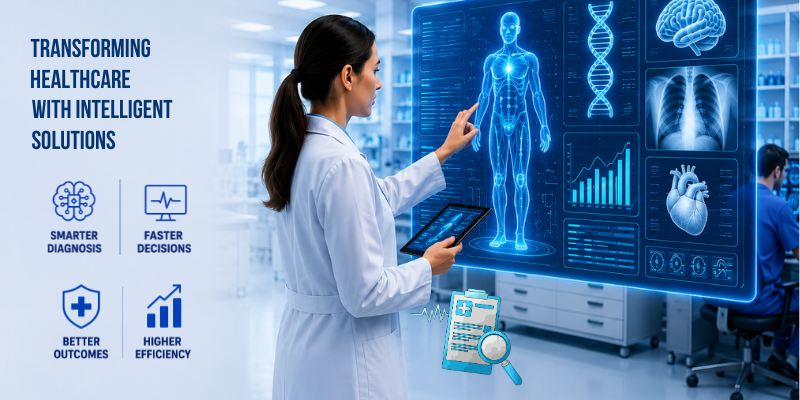
Early Identification of Diseases
Early diagnosis plays a critical role in successful treatment outcomes. Healthcare systems now use advanced diagnostic tools to identify warning signs of diseases before symptoms become severe.
This approach is especially valuable in conditions such as cancer, heart disease, neurological disorders, and respiratory illnesses where early intervention can significantly improve survival rates and reduce complications.
Improved Diagnostic Speed
Traditional diagnosis often involves multiple evaluations, repeated testing, and lengthy reporting procedures. Modern healthcare technologies help reduce this waiting time by processing medical data much faster.
Doctors can review imaging results, laboratory findings, and patient histories more efficiently, allowing quicker treatment decisions and better patient management.
Reduced Human Error in Reporting
Healthcare professionals work under intense pressure, especially in busy hospitals and emergency departments. Advanced diagnostic systems help reduce reporting errors by improving data accuracy and supporting medical evaluations with additional analysis.
This support allows healthcare teams to work more confidently while maintaining higher standards of patient safety.
2.Medical Imaging and Scan Analysis
X-Ray Interpretation
Modern imaging systems help radiologists analyze X-rays more efficiently by highlighting suspicious areas that may require further evaluation. This improves diagnostic consistency and supports faster reporting.
MRI and CT Scan Analysis
MRI and CT scans generate highly detailed medical images that require careful interpretation. Advanced imaging technologies assist healthcare professionals by analyzing these scans quickly and identifying abnormalities linked to serious conditions.
This support is especially important in neurological disorders, internal injuries, cancer screening, and cardiovascular disease diagnosis.
Faster Radiology Workflows
Radiology departments often handle large numbers of imaging reports every day. Automated imaging support systems help prioritize urgent cases, reduce reporting delays, and improve workflow management for healthcare professionals.
3.Predictive Healthcare and Risk Assessment
Identifying High-Risk Patients
Healthcare providers now use predictive systems to identify patients who may face higher risks of developing serious medical conditions. This allows hospitals to monitor vulnerable patients more closely and provide earlier medical intervention.
Preventive Healthcare Systems
Preventive healthcare focuses on reducing disease risks before conditions become severe. Modern healthcare technologies support preventive care by analyzing patient histories, lifestyle factors, and clinical data to identify possible health concerns earlier.
Predicting Disease Progression
Some medical conditions worsen gradually over time. Predictive healthcare systems help doctors monitor disease progression and adjust treatment plans according to changes in patient health.
This approach improves long-term patient management and supports better treatment outcomes.
4.Virtual Health Assistants and Patient Support
Symptom Checking Systems
Virtual healthcare platforms help patients review common symptoms and receive guidance about possible medical concerns. These systems improve healthcare accessibility while reducing unnecessary hospital visits for minor conditions.
Appointment Management
Healthcare facilities use digital systems to schedule appointments, manage patient communication, and reduce administrative workload. This improves efficiency for both patients and healthcare staff.
Remote Healthcare Support
Remote healthcare services allow doctors to monitor patients outside traditional hospital settings. This is especially useful for elderly patients, chronic disease management, and individuals living in remote areas.
5.Personalized Treatment Planning
Customized Treatment Recommendations
Every patient responds differently to medical treatment. Modern healthcare systems help doctors develop treatment strategies based on individual patient conditions, medical history, and diagnostic findings.
Patient-Specific Healthcare Decisions
Personalized healthcare improves treatment accuracy by focusing on the specific needs of each patient instead of relying only on generalized medical approaches.
Data-Based Therapy Planning
Healthcare providers now use clinical data and patient monitoring systems to support therapy planning and improve long-term treatment management.
6.Drug Discovery and Pharmaceutical Research
Faster Medicine Development
Developing new medicines traditionally requires years of research and testing. Advanced pharmaceutical technologies help researchers analyze medical compounds more efficiently and shorten development timelines.
Identifying Treatment Compounds
Researchers use healthcare data analysis to study chemical structures and identify compounds with strong potential for future medicines.
Improving Clinical Trials
Clinical trials require careful patient selection and detailed monitoring. Modern research systems improve trial efficiency by organizing medical data, identifying suitable participants, and supporting treatment analysis.
7.Hospital Automation and Workflow Efficiency
Smart Hospital Management
Hospitals now use digital management systems to coordinate patient care, monitor hospital resources, and improve operational efficiency.
Automated Documentation
Medical documentation consumes significant time for healthcare professionals. Automated systems help organize clinical notes, patient histories, and treatment records more efficiently.
ICU Monitoring Systems
Intensive care units require continuous patient observation. Modern monitoring systems track vital signs in real time and alert healthcare teams about sudden changes in patient conditions, allowing faster medical response during emergencies.
AI in Medical Imaging and Diagnostics
Medical imaging plays an essential role in modern healthcare because doctors depend on scans and laboratory reports to diagnose serious diseases accurately. Advanced healthcare technologies now help radiologists and laboratory specialists analyze medical data more efficiently, improving both speed and diagnostic precision.
AI in Radiology
Radiology departments handle thousands of medical scans every day, including X-rays, MRI scans, and CT scans. Intelligent imaging systems help doctors detect abnormalities faster by highlighting suspicious areas that may require further evaluation.
These technologies also improve the interpretation of medical images, allowing radiologists to identify conditions such as fractures, tumors, infections, and internal injuries more efficiently. Faster image analysis reduces reporting delays and supports faster treatment decisions in emergency situations.
Another major benefit is workload reduction. Radiologists often work under heavy pressure, especially in busy hospitals. Automated imaging support systems help manage large volumes of scans while improving overall workflow efficiency.
AI in Pathology and Laboratory Analysis
Digital pathology systems are improving how tissue samples and laboratory reports are analyzed. Modern healthcare technologies assist pathologists in examining microscopic images more accurately and identifying disease-related abnormalities within tissue samples.
Automated laboratory reporting also helps hospitals organize diagnostic results faster and reduce manual documentation work. This improves communication between healthcare departments and supports more efficient patient care.
Real-Time Diagnostic Assistance
Real-time diagnostic systems provide immediate support in emergency departments and intensive care units where rapid medical decisions are critical. These technologies continuously monitor patient conditions and alert healthcare teams about sudden changes in vital signs or disease progression.
Clinical decision support systems also help doctors review patient information immediately, improving treatment planning and emergency response efficiency.
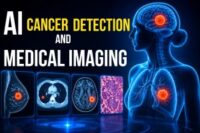
For a detailed discussion on imaging technologies and advanced disease screening, explore our article on AI in Cancer Detection and Medical Imaging.
AI in Disease Detection
Disease detection has become one of the most important applications of intelligent healthcare systems. Early diagnosis helps doctors to begin treatment sooner, improve recovery chances, and decrease long-term health complications.
Early Detection of Chronic Diseases
Modern healthcare technologies help doctors identify chronic conditions such as heart disease, neurological disorders, and respiratory illnesses at earlier stages. Early detection improves treatment outcomes and helps patients manage their health more effectively.
Hospitals also use predictive healthcare systems to monitor high-risk patients and reduce severe medical complications.
AI in Cancer Detection
Cancer diagnosis requires high accuracy because delayed detection can significantly affect treatment success. Advanced imaging and diagnostic systems assist healthcare professionals in breast cancer screening, lung cancer identification, and tumor analysis.
These technologies help doctors examine medical scans efficiently and identify suspicious abnormalities that may require additional testing.
Improving Diagnostic Accuracy
Modern healthcare systems improve diagnosis by identifying hidden disease patterns within medical data. This support helps healthcare professionals make more informed clinical decisions while reducing the risk of delayed diagnosis.
Advanced diagnostic technologies also improve consistency in medical reporting, particularly in complex disease cases where precision is critical.
To learn more about advanced imaging technologies and cancer screening systems, read our article on AI in Cancer Detection and Medical Imaging.
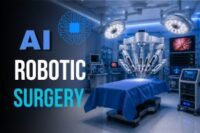
AI in Robotic Surgery and Smart Surgical Systems
Robotic surgery is changing how complex medical procedures are performed in modern hospitals. Smart surgical technologies support surgeons during operations by improving precision, stability, and control.
Role of Smart Surgical Technologies
Advanced surgical systems assist doctors with precision-based procedures and real-time surgical guidance. These technologies help surgeons perform delicate operations with greater accuracy, especially in complex medical cases.
Robotic systems are now widely used in areas such as cardiac surgery, neurological procedures, and minimally invasive operations.
Benefits of Robotic Surgery
One major advantage of robotic surgery is reduced recovery time. Smaller surgical incisions often lead to less pain, reduced blood loss, and faster healing for patients.
These technologies also improve surgical precision, helping doctors perform procedures more safely while reducing complications during surgery.
For a detailed explanation of intelligent surgical systems and advanced operating technologies, explore our article on AI in Robotic Surgery and Smart Surgical Systems.
AI in Dentistry and Dental Diagnostics
Dental healthcare is also benefiting from advanced diagnostic technologies. Modern dental systems help dentists analyze imaging results more accurately and improve treatment planning for patients.
Smart Dental Imaging
Dental X-ray analysis systems assist dentists in identifying cavities, gum disease, and structural dental problems at earlier stages. Faster imaging analysis improves diagnosis accuracy and supports better patient care.
Automated Dental Analysis
Automated dental technologies also support orthodontic planning and smile simulation systems. These tools help dentists create personalized treatment plans while improving communication with patients about expected results.
Advanced diagnostic systems reduce delays in dental evaluations and improve overall efficiency in dental clinics.
Learn more about modern dental technologies in our article on AI in Dentistry, Dental Imaging, and Automated Dental Analysis.
AI in Drug Discovery and Personalized Treatment
Pharmaceutical research and personalized medicine are evolving rapidly as healthcare technologies improve medical analysis and treatment development.
Faster Drug Development
Traditional medicine development often requires years of research and testing. Modern pharmaceutical technologies help researchers analyze compounds more efficiently and identify potential medicines faster.
This approach reduces development timelines and supports faster innovation in healthcare research.
Personalized Healthcare
Personalized healthcare focuses on creating treatment plans based on individual patient conditions, genetic information, and medical history. This improves treatment effectiveness and supports better long-term patient outcomes.
Precision medicine approaches also help doctors choose therapies that match specific patient needs instead of relying only on generalized treatment methods.
To explore pharmaceutical innovation and customized treatment planning in detail, read our article on AI in Drug Discovery and Personalized Treatment.
Benefits of AI in Healthcare and Diagnosis
Modern healthcare systems are improving rapidly as hospitals adopt advanced technologies to support diagnosis, treatment planning, and patient care. These systems help healthcare professionals work more efficiently while improving the quality of medical services.
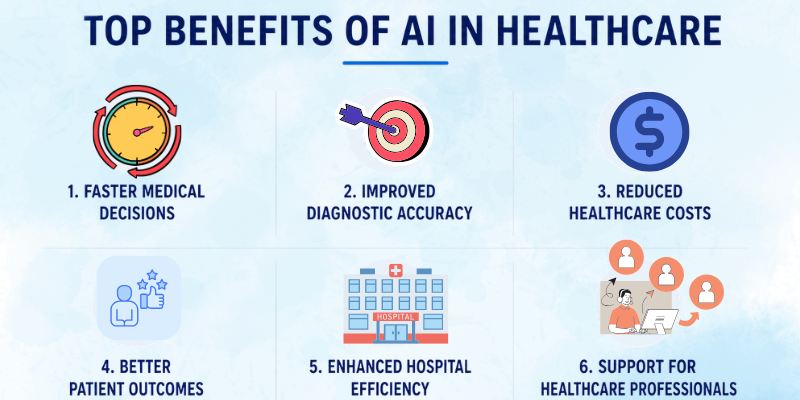
Faster Medical Decisions
Quick decision-making is critical in healthcare, especially during emergencies and critical care situations. Advanced diagnostic systems help doctors analyze patient information faster, allowing quicker treatment decisions and improved emergency response.
Improved Diagnostic Accuracy
Modern healthcare technologies assist doctors in identifying diseases more accurately by analyzing medical scans, laboratory reports, and patient histories. This reduces diagnostic errors and supports more reliable treatment planning.
Reduced Healthcare Costs
Hospitals face increasing operational expenses due to growing patient demands and complex healthcare procedures. Automated systems improve workflow efficiency, reduce administrative burden, and help healthcare providers manage resources more effectively.
Better Patient Outcomes
Early disease detection and accurate diagnosis improve treatment success rates. Patients benefit from faster medical attention, personalized care, and more effective long-term treatment strategies.
Enhanced Hospital Efficiency
Healthcare facilities use digital systems to improve hospital operations, manage patient records, organize appointments, and support communication between departments. This creates a more organized and efficient healthcare environment.
Support for Healthcare Professionals
Doctors, radiologists, nurses, and laboratory specialists often work under intense pressure. Advanced healthcare systems support medical professionals by reducing repetitive tasks and helping them focus more on patient care and clinical decision-making.
Challenges and Ethical Concerns
Although modern healthcare technologies offer many advantages, several challenges still affect their safe and responsible use in medicine. Healthcare providers must address these concerns carefully to maintain patient trust and healthcare quality.
Patient Data Privacy
Hospitals store large amounts of sensitive patient information, including medical histories, diagnostic reports, and treatment records. Protecting this data from unauthorized access remains one of the biggest concerns in digital healthcare systems.
Bias in Healthcare Algorithms
Healthcare systems depend heavily on medical data for analysis and diagnosis. If the data used during system development lacks diversity or accuracy, diagnostic outcomes may become unfair or inconsistent for certain patient groups.
Regulatory and Legal Issues
Healthcare technologies must follow strict medical regulations and safety standards. Governments and healthcare organizations continue working on policies that ensure patient safety, data protection, and responsible medical use.
Dependence on Technology
Modern healthcare systems provide valuable support, but excessive dependence on technology may create risks if systems fail or produce inaccurate results. Medical professionals still need strong clinical judgment during diagnosis and treatment decisions.
Need for Human Oversight
Healthcare technologies support doctors but cannot replace human expertise, patient communication, or medical ethics. Final medical decisions should always remain under professional supervision to ensure safe and responsible patient care.
Future of AI in Healthcare
Healthcare systems will continue evolving as medical technologies become more advanced, accurate, and widely accessible. Future healthcare environments are expected to focus more on prevention, personalized treatment, and faster patient care.
Predictive and Preventive Medicine
Future healthcare systems will focus increasingly on identifying disease risks before serious symptoms appear. Predictive technologies may help doctors detect health conditions earlier and encourage preventive treatment strategies that improve long-term patient outcomes.
Smart Hospitals and Digital Healthcare
Hospitals are gradually becoming more connected through digital healthcare systems, automated monitoring tools, and advanced patient management platforms. Smart hospitals may improve operational efficiency while reducing delays in diagnosis and treatment.
Future Collaboration Between Doctors and AI Systems
Healthcare professionals and advanced medical systems will work more closely together in the future. Doctors will continue leading patient care while using intelligent technologies to support diagnosis, imaging analysis, and treatment planning.
Expanding Global Healthcare Access
Remote healthcare technologies may improve medical access for people living in underserved or rural areas. Digital healthcare platforms can help patients connect with specialists and receive medical support without traveling long distances.
Future Innovations in Diagnosis and Treatment
Future medical advancements may improve robotic surgery, personalized medicine, disease prediction, and healthcare monitoring systems. As healthcare technologies continue developing, hospitals may deliver faster, safer, and more accurate patient care across multiple medical fields.
Conclusion
Healthcare is changing rapidly, and throughout this guide, we explored how AI in healthcare and medical diagnosis is improving disease detection, medical imaging, robotic surgery, dental diagnostics, personalized treatment, and hospital efficiency. Modern healthcare systems are helping doctors make faster decisions, improve diagnostic accuracy, and provide better patient care across multiple medical fields.
At the same time, technology alone cannot replace the experience, judgment, and compassion of healthcare professionals. Doctors, nurses, radiologists, and medical specialists remain the foundation of quality patient care. Advanced healthcare systems work best when they support medical experts instead of replacing human involvement.
My recommendation for healthcare providers, medical students, and even patients is to stay informed about these advancements because the future of medicine will depend heavily on responsible healthcare innovation. Understanding these technologies today can help people prepare for the healthcare systems of tomorrow.
Folks, healthcare is entering a completely new era, and we are only beginning to see its full potential. Keep learning, stay curious, and stay tuned for more insights on the future of modern medicine.
FAQs
1. How is AI used in healthcare and medical diagnosis?
AI in healthcare and medical diagnosis is used to analyze medical records, imaging scans, laboratory reports, and patient data. Hospitals use these systems to support disease detection, improve treatment planning, and reduce diagnostic delays. It also helps doctors make faster clinical decisions in critical situations.
2. Can AI improve the accuracy of medical diagnosis?
Yes, advanced healthcare systems can improve diagnostic accuracy by identifying patterns in medical data that may be difficult to notice manually. These technologies support doctors during imaging analysis, cancer screening, and disease detection. However, final medical decisions still depend on healthcare professionals.
3. What are the benefits of AI in healthcare?
The biggest benefits include faster diagnosis, improved patient care, reduced medical errors, and better hospital efficiency. Healthcare providers also use advanced systems to manage patient records and support personalized treatment planning. These improvements help hospitals deliver more effective healthcare services.
4. Is AI replacing doctors in healthcare?
No, AI is not replacing doctors. Healthcare technologies are designed to support medical professionals, not remove human involvement from patient care. Doctors still play the most important role in diagnosis, treatment decisions, and communication with patients.
5. What is the future of AI in healthcare and medical diagnosis?
The future of healthcare will focus more on early disease detection, personalized treatment, smart hospitals, and preventive medicine. Advanced technologies are expected to improve healthcare access and help doctors manage patients more efficiently. Many hospitals are already investing heavily in digital healthcare systems for long-term medical innovation.


- Be Respectful
- Stay Relevant
- Stay Positive
- True Feedback
- Encourage Discussion
- Avoid Spamming
- No Fake News
- Don't Copy-Paste
- No Personal Attacks
- Be Respectful
- Stay Relevant
- Stay Positive
- True Feedback
- Encourage Discussion
- Avoid Spamming
- No Fake News
- Don't Copy-Paste
- No Personal Attacks
