AI in Cancer Detection and Medical Imaging
Published: 23 May 2026
Too often, the hardest part of cancer is not the treatment, it is hearing the words “we found it too late”.
Cancer remains one of the biggest health challenges worldwide, and in many cases, it’s not the disease itself but the delay in catching it that costs the most. Traditional diagnosis relies on manual image review and specialist judgment, methods that are essential but can be slow and sometimes miss very small abnormalities hidden in a scan.
This is where AI in cancer detection is quietly changing the game. By analyzing MRI scans, CT scans, mammograms, and X-rays with remarkable speed and precision, artificial intelligence is helping doctors catch tumors and early warning signs that aren’t always visible to the human eye.
According to the National Cancer Institute, early detection remains one of the most important factors in successful cancer treatment, and that’s exactly where AI is making the biggest difference.
In this article, you’ll learn how AI cancer diagnosis systems work, the technology behind modern medical imaging, the types of cancers AI can detect, real-world applications, benefits, challenges, and where this field is headed next.
What Is AI in Cancer Detection and Medical Imaging?
Behind every scan a radiologist reviews, there’s now a second set of “eyes” working alongside them, tireless, fast, and trained on millions of images.
AI in cancer detection and medical imaging refers to artificial intelligence systems that analyze medical scans, identify abnormal tissue patterns, and support doctors during diagnosis. Using machine learning, deep learning, and image recognition, these systems examine MRI scans, CT scans, mammograms, pathology slides, and X-rays with remarkable speed, helping catch possible signs of cancer before the disease advances.
One of the biggest advantages here is earlier diagnosis. Early-stage tumors are often tiny and easy to miss during a traditional review, but AI can highlight suspicious areas and measure abnormal growth patterns that might otherwise slip through.
“Deep learning systems are showing strong potential for improving cancer detection accuracy, especially in imaging-heavy areas like lung and breast screening.”
Traditional diagnosis still relies on manual image interpretation by radiologists, and while that expertise remains essential, it can be slowed down by time pressure and heavy workloads. AI-powered imaging helps ease that load through automated analysis and faster reporting.
Role of Artificial Intelligence in Oncology
AI is becoming a core part of modern oncology, helping healthcare professionals process large volumes of medical data far more efficiently than manual review alone.
- Supports cancer screening, tumor detection, pathology analysis, treatment planning, and patient monitoring
- Helps doctors spot cancer-related abnormalities earlier and make more confident decisions
- Analyzes patient scans within seconds, reducing delays across radiology and oncology workflows
The result isn’t AI replacing doctors, it’s AI and human expertise working together to make healthcare move faster.
Importance of AI in Medical Imaging
Since many cancers are first spotted through scans, medical imaging is where early detection really begins. AI improves this process by increasing analysis speed and supporting more consistent image interpretation, something that matters most in diseases like breast cancer, lung cancer, brain tumors, and prostate cancer, where early detection can make or break treatment outcomes. As patient scan volumes grow, AI is also helping hospitals manage that workload without overwhelming radiology departments.
How AI Supports Cancer Diagnosis Accuracy
AI improves diagnostic accuracy by training on massive healthcare datasets, learning to tell the difference between healthy and abnormal tissue with each scan it processes.
- Compares thousands of imaging examples to spot suspicious growth patterns
- Gives healthcare professionals an extra layer of diagnostic support during screening
- According to research available through PubMed Central, AI-assisted imaging can improve diagnostic consistency and help reduce human error in certain radiology workflows
AI doesn’t replace doctors here either, it acts as a powerful support system that helps specialists make faster, more informed clinical decisions.
Why Early Cancer Detection Is Important
Cancer caught early is often a very different story from cancer caught late, and that gap is exactly why early detection matters.Many cancers grow quietly and show no clear symptoms in the beginning. By the time they are noticed, the disease may have spread, making treatment harder, costlier, and more draining for patients.According to the National Cancer Institute, cancer screening looks for cancer before symptoms appear, when it may be easier to treat.
What Happens When Diagnosis Is Delayed
Advanced stage cancers usually need heavier treatment:
- Surgery, chemotherapy, or radiation therapy become more likely
- Long term treatment plans may be needed
- Costs and physical strain on patients go up
The Role of Imaging in Early Detection
Many cancers are first spotted through scans like MRI, CT, mammography, ultrasound, and X-rays. Imaging also tracks cancer progression, shows how well treatment is working, and helps plan surgery. As cases rise worldwide, hospitals are investing in AI healthcare diagnostics to speed up screening and cut diagnostic delays.
How AI Cancer Detection and Medical Imaging Systems Work
Behind every AI assisted diagnosis is a simple three step process: collect the scan, analyze it, and flag what needs a doctor’s attention.
Medical Image Analysis and Deep Learning in Cancer Detection
It starts with imaging data from MRI scans, CT scans, X-rays, and mammography. AI cancer diagnosis systems process these images using deep learning models trained on thousands of examples, which teaches them to tell healthy tissue from potentially cancerous abnormalities. Each imaging type has its own strength:
- MRI: brain tumors, soft tissue abnormalities, and neurological cancers
- CT scans: internal tumors and cancer spread in organs like the lungs and abdomen
- X-rays: chest abnormalities and bone related cancers
- Mammography: early breast cancer screening
Once trained, the system highlights suspicious regions for closer medical review, including tiny changes that are easy to miss in a manual read.
AI-Assisted Cancer Diagnosis
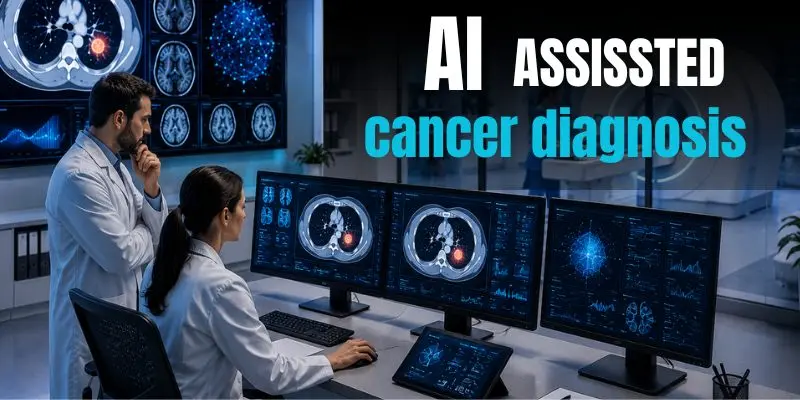
Here, imaging technology meets intelligent software to give doctors extra diagnostic insight during clinical evaluation.
- Radiology AI tools analyze scans and point out possible cancer indicators faster
- AI pathology systems examine tissue samples and slides for abnormal cell structures, improving consistency and cutting manual workload
- Predictive models estimate cancer risk from imaging data, medical history, and clinical patterns, helping prioritize high risk cases
Real-Time Monitoring and Automated Reporting
One big advantage of AI healthcare diagnostics is speed. Scans are processed rapidly and turned into automated reports that organize findings, highlight suspicious areas, and keep radiologists and care teams on the same page, so specialists can spend more time on complex cases.
AI also supports long term care by tracking imaging changes over time, monitoring tumor progression, and helping evaluate treatment, so doctors can respond quickly when a patient’s condition changes.
Technologies Used in AI Cancer Detection and Medical Imaging
No single tool does the job alone. Modern AI cancer detection works because several technologies run together, each handling a different part of the process.
Artificial Intelligence and Machine Learning
These are the foundation of AI healthcare diagnostics. Machine learning systems learn from large datasets of medical images to recognize patterns linked to cancer, and they keep getting better as they process more data.
Deep Learning in Medical Imaging
Deep learning uses layered neural networks to read scans in fine detail and pick up complex tissue patterns tied to different cancer types. It is widely used across:
- MRI and CT scan analysis
- Mammography imaging
- Pathology slide review
Computer Vision and Image Recognition
Computer vision lets AI “see” medical scans and pathology images, automatically spotting tumors, tissue irregularities, and abnormal growth structures. This makes scan interpretation faster and more consistent during screening.
Radiology AI Systems and Diagnostic Software
These are the platforms doctors actually work with day to day. Radiology AI tools and hospital diagnostic software plug into existing imaging equipment and healthcare databases to handle:
- Image review and abnormality detection
- Workflow management
- Automated diagnostic reporting
Cloud Computing and Healthcare Data Analytics
Cloud platforms let hospitals store and analyze huge volumes of imaging data securely, and they support AI model training across connected medical networks. They also give hospitals, radiologists, and oncology specialists one shared place to access scans and collaborate.
Types of Cancer Detected Using AI
AI is not one tool for one disease. It is trained separately for each cancer, based on the scan type and the signs doctors need to catch.
AI in Breast Cancer Detection
AI mammography analysis helps radiologists spot suspicious tissue patterns, microcalcifications, and small abnormalities during breast cancer screening.
AI in Lung Cancer Detection
By combining CT scan analysis with image recognition, AI lung cancer detection systems identify lung nodules and abnormal tissue growth that are easy to miss in a busy reading room.
AI in Brain Cancer Detection
Brain tumors are mostly diagnosed through MRI. AI medical imaging tools analyze these scans, mark tumor regions, and support specialists in evaluation and treatment planning.
AI in Skin Cancer Detection
AI dermatology systems study skin images and look for:
- Abnormal mole patterns
- Pigmentation changes
- Possible cancerous lesions, including melanoma
AI in Prostate Cancer Detection
AI in prostate cancer detection combines pathology analysis with imaging to help doctors examine tissue samples and flag cancer related abnormalities.
AI in Colorectal Cancer Detection
Working with colon imaging and automated screening, AI helps identify abnormal tissue growth, polyps, and early signs of colorectal cancer.
AI in Oral and Dental Cancer Detection
AI dental imaging systems use lesion analysis and radiograph interpretation to flag suspicious changes in oral tissue, adding a useful second check in modern dentistry.
Real-World Examples of AI Cancer Detection Systems
AI cancer detection is no longer just a lab experiment. These projects show what it can already do for tumor detection and screening.
Google: Breast and Lung Cancer Screening
Google’s medical AI work has focused on two areas:
- AI mammography: models that help radiologists catch abnormalities in breast scans more efficiently
- Lung cancer on CT scans: an AI model for lung cancer screening that performed as well as or better than trained radiologists in the study
NYU Researchers: Lung Cancer Pathology
A team at NYU trained a deep learning model on tissue slides to tell normal lung tissue from tumor tissue and to separate two common lung cancer types. The published NYU study reports performance comparable to a pathologist.
Advantages and Disadvantages of AI in Cancer Detection
Several advantages and disadvantages are described below:
Advantages
Following are the advantages of AI in cancer detection:
- Faster Diagnosis
AI systems analyze medical scans quickly, helping healthcare professionals reduce delays in cancer screening and diagnosis. - Improved Imaging Accuracy
Advanced imaging analysis helps identify abnormal tissue patterns with greater precision during radiology examinations. - Early Tumor Detection
AI cancer detection tools can recognize small abnormalities and early-stage tumors before the disease progresses further. - Reduced Human Error
Automated image analysis supports radiologists by minimizing missed abnormalities during complex medical imaging reviews. - Better Treatment Planning
AI healthcare diagnostics help doctors evaluate imaging results more efficiently and support personalized treatment decisions. - Enhanced Radiology Workflow
AI-powered systems improve workflow management in hospitals by handling large volumes of medical imaging data more effectively.
Disadvantages
Following are the disadvantages of AI in detection of tumors:
- High Implementation Costs
Installing AI healthcare systems and advanced imaging technologies can require significant financial investment for hospitals and diagnostic centers. - Dependence on Quality Medical Data
AI systems rely heavily on accurate medical datasets and imaging records to deliver reliable diagnostic results. - Technical and Ethical Challenges
Healthcare organizations must address issues related to system reliability, medical responsibility, and ethical use of patient information. - Risk of Diagnostic Errors
Although AI improves imaging analysis, incorrect predictions or incomplete data may sometimes affect diagnostic accuracy. - Data Privacy Concerns
Managing large amounts of patient imaging data raises concerns about cybersecurity, medical confidentiality, and healthcare data protection.
AI Cancer Detection vs Traditional Cancer Diagnosis
| Factor | AI Cancer Detection | Traditional Diagnosis |
| Imaging Speed | Faster automated analysis | Slower manual review |
| Accuracy | High precision detection | Human-dependent accuracy |
| Monitoring | Continuous data analysis | Limited manual monitoring |
| Workflow Efficiency | Improved radiology workflow | Time-consuming process |
| Scalability | Supports large patient volumes | Limited by workforce |
Future of AI in Cancer Detection, Precision Oncology, and Smart Medical Imaging Systems
Today, AI mainly helps doctors read scans. Tomorrow, it may help decide what happens next.
The future of AI in cancer detection is expected to reach beyond the scan itself, shaping oncology research, treatment choices, and where patients can get care.
AI-Powered Precision Oncology and Personalized Treatment
Precision oncology uses AI to bring together patient data, medical imaging, and genetic information, so treatment can be matched to each patient. Future systems are expected to go further by studying tumor behavior, patient history, and treatment response, which may help improve effectiveness and reduce unnecessary procedures.
Advanced Deep Learning Models
Deep learning is still maturing in medical imaging. Future models are expected to improve:
- Tumor detection accuracy
- Imaging interpretation
- Predictive diagnostics across multiple cancer types
AI-Assisted Remote Cancer Screening
In rural and underserved regions, specialists can be hard to reach. Cloud-based imaging platforms and AI diagnostic tools may help bring screening to these areas, even when specialists are not on site.
AI in Smart Hospitals
Smart hospitals are starting to connect AI healthcare diagnostics, automated imaging systems, and digital patient management into one system. The expectation is smoother radiology workflows, better patient monitoring, and more efficient oncology care.
Conclusion
AI in cancer detection and medical imaging is changing how healthcare professionals identify and manage cancer, improving diagnostic accuracy, supporting radiologists, and helping detect cancers at earlier stages across multiple specialties.
Early diagnosis remains one of the biggest factors in successful cancer treatment. As AI-powered medical imaging continues to improve screening efficiency and reduce diagnostic delays, it’s playing an increasingly important role in precision oncology and hospital imaging systems worldwide.
That said, AI is a support system, not a replacement. The combination of human expertise and AI-assisted diagnostics is what truly improves patient care and treatment planning. As oncology becomes more data-driven and connected, healthcare professionals who adapt early will be best prepared for what comes next.
This article is for informational purposes only and does not replace professional medical advice. Please consult a qualified healthcare provider for diagnosis or treatment related to cancer.
FAQs
1. What is AI cancer detection?
AI cancer detection uses artificial intelligence to spot cancer through medical imaging and healthcare data, helping doctors identify abnormal tissue patterns early.
2. How does AI detect cancer in medical images?
AI analyzes MRI, CT, mammogram, and X-ray scans using deep learning, comparing patterns against large datasets to flag abnormalities that might otherwise go unnoticed.
3. Which cancers can AI identify?
AI is already used across several major cancer types:
- Breast cancer
- Lung cancer
- Brain tumors
- Skin cancer
- Prostate cancer
- Colorectal cancer
- Oral cancer
4. How accurate is AI in cancer detection compared to traditional diagnosis?
Accuracy depends on the cancer type, the quality of the scans, and the specific AI system. In some tasks, such as lung cancer screening on CT scans, studies have found AI performing as well as or better than trained radiologists, and it can help reduce missed abnormalities during scan analysis. Results are not the same for every cancer or every tool.
5. What technologies are used in AI medical imaging?
A mix of advanced technologies makes this possible:
- Machine learning and deep learning
- Computer vision and radiology AI systems
- Cloud computing and healthcare data analytics
6. Is AI cancer screening expensive or covered by insurance?
Costs vary by hospital, country, and the type of screening. Where AI is used as part of a standard scan like a mammogram or CT, you may not see a separate charge, but this differs between providers. Check with your hospital or insurer before your appointment.
7. Which hospitals use AI for cancer detection?
AI imaging tools are used in a growing number of hospitals and diagnostic centers, though availability depends on your region and provider. The simplest way to find out is to ask your hospital or radiologist directly.
8. Can AI detect cancer on its own without a doctor?
Not quite, AI supports doctors, it doesn’t replace them:
- It flags suspicious areas faster than manual review
- A qualified doctor always confirms the final diagnosis




- Be Respectful
- Stay Relevant
- Stay Positive
- True Feedback
- Encourage Discussion
- Avoid Spamming
- No Fake News
- Don't Copy-Paste
- No Personal Attacks
- Be Respectful
- Stay Relevant
- Stay Positive
- True Feedback
- Encourage Discussion
- Avoid Spamming
- No Fake News
- Don't Copy-Paste
- No Personal Attacks
