AI Crop Disease Detection: Transforming Modern Agriculture with Smart Technology
Published: 3 Sep 2026
Crop diseases cause major losses every year, often because traditional inspection methods detect problems too late.
AI crop disease detection solves this. Using artificial intelligence, image recognition, drones, and smart sensors, farmers can now spot plant diseases faster and more accurately, catching issues before they spread and acting on data instead of guesswork.
Already used in wheat, rice, fruit, and vegetable farming, it’s helping cut crop losses, reduce pesticide use, and boost productivity, key to smart, sustainable agriculture.
In this guide, you’ll learn how AI crop disease detection works, its technologies, applications, benefits, and future potential.
What Is AI Crop Disease Detection?
AI crop disease detection uses artificial intelligence to identify plant diseases quickly and accurately by analyzing images, patterns, and field data, helping farmers catch problems early instead of relying only on manual inspection.
How AI Analyzes Plant Health
- Collects images of leaves, stems, and crops via smartphones, drones, or smart cameras
- Compares them with stored data to spot disease, nutrient deficiency, or abnormalities
- Detects problems before they spread across the field
Role of Image Recognition and Machine Learning
- Image recognition identifies symptoms like leaf spots and discoloration
- Machine learning improves accuracy by studying thousands of crop images
- Gets better at recognizing diseases across different weather and field conditions
AI vs. Traditional Disease Detection
- Traditional: relies on manual inspection and farmer experience, often slow and less accurate
- AI-based: monitors crops in real time, reduces human error, enables faster decisions
Why Crop Disease Detection Is Important
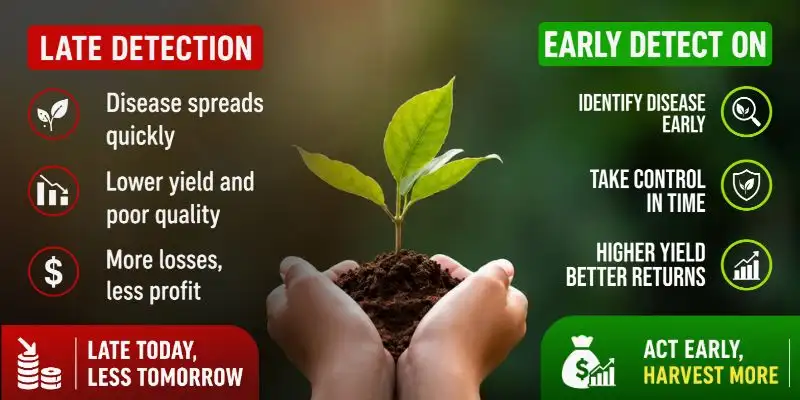
Crop diseases directly hurt agricultural productivity and farm income, causing reduced growth, lower quality, and major yield loss when infections spread unchecked.
Impact on Yield and Profits
- Damages leaves, roots, and fruits, weakening overall plant health
- Lowers production quality and market value
- Even small losses hit hard in large-scale farming
Cost of Late Disease Identification
- Requires heavier pesticide use once diseases spread widely
- Increases overall treatment and farming costs
- Severe cases can make entire crops unsellable
Why Early Prevention Matters
- Stops infections before they spread widely
- Protects healthy crops and reduces excess chemical use
- Improves crop quality and supports stable production
Role in Food Security and Sustainability
- Supports stable food supply by preventing large-scale crop failure
- Reduces unnecessary pesticide use
- Protects long-term environmental health
How AI Crop Disease Detection Works
AI crop disease detection combines image collection, machine learning, and real-time monitoring to help farmers catch diseases early and act fast. Here’s how it works:
1. Image Collection and Data Input
- Smartphone cameras, drones, and smart sensors capture images of leaves, stems, and fruits
- High-quality images improve detection accuracy
- Continuous data collection tracks plant health across growth stages
2. AI Image Analysis
- Machine learning studies patterns like discoloration, leaf spots, and unusual growth
- AI compares healthy vs. infected plant samples to identify diseases accurately
- The model keeps improving as more data is processed
3. Disease Prediction and Recommendations
- Analyzes weather, crop health, and past disease patterns to predict outbreak severity
- Generates treatment recommendations (pesticide use, irrigation, nutrient management)
- Reduces unnecessary chemical use while improving management efficiency
4. Continuous Monitoring
- Sensors, drones, and cameras track crop conditions in real time
- Early warning alerts notify farmers as soon as symptoms appear
- Reduces reliance on manual inspection and lowers risk of major losses
Technologies Used in Crop Disease Detection Systems
Modern crop monitoring systems rely on a combination of advanced digital tools that work together to identify plant health issues at an early stage. Each component plays a specific role in making detection faster, more reliable, and scalable across different farm sizes.
Artificial Intelligence and Machine Learning
These systems are built on models that learn from large sets of plant images and field data. By studying patterns such as discoloration, spots, or leaf deformation, the system improves its ability to recognize similar issues in new samples over time. This learning-based approach allows consistent performance even when conditions vary across regions and seasons.
Computer Vision Technology
This technology enables machines to interpret visual information from images and videos. It breaks down plant visuals into measurable features like shape, texture, and color differences. By analyzing these details, the system can distinguish between healthy crops and those showing early signs of stress or infection with a high level of precision.
Drones and Smart Cameras
Aerial devices and high-resolution cameras are used to capture large-scale field images quickly. Drones cover wide agricultural areas in a short time, while fixed or handheld cameras provide closer inspection of plants. This combination helps in collecting detailed visual data without requiring manual field checks for every section of land.
Internet of Things Sensors in Agriculture
Small connected sensors placed in soil and fields continuously record environmental conditions such as moisture, temperature, and humidity. These readings help in understanding the factors that contribute to plant stress. When combined with visual data, they provide a more complete picture of crop health.
Cloud Computing and Data Analytics
All collected information is stored and processed through remote computing systems. This setup allows large volumes of data from multiple farms to be analyzed efficiently. It also enables farmers and experts to access insights from anywhere, supporting timely decisions based on real field conditions.
Applications of Crop Disease Detection Systems
Modern plant health monitoring methods are being used across a wide range of agricultural sectors. Their purpose is to support early identification of issues, improve yield quality, and reduce losses in different farming environments.
Wheat and Rice Farming
Staple crops such as wheat and rice are highly sensitive to fungal infections, pests, and weather-related stress. Monitoring systems help farmers detect early signs of damage across large fields where manual inspection is difficult. This allows timely intervention, protecting both quantity and grain quality during critical growth stages.
Fruit and Vegetable Production
Perishable crops require close attention because even small infections can spread quickly. Visual monitoring tools assist growers in identifying surface changes, discoloration, and texture abnormalities in fruits and vegetables. This supports better grading, reduces waste, and improves market value.
Greenhouse Farming
Controlled environments like greenhouses benefit from continuous observation of plant conditions. Monitoring tools help track subtle changes caused by humidity imbalance, nutrient deficiency, or disease development. Since crops grow in confined spaces, early detection prevents rapid spread and protects the entire batch.
Large-Scale Commercial Agriculture
Extensive farming operations rely on fast and efficient oversight of vast land areas. Aerial monitoring and connected systems provide coverage that would otherwise require significant manpower. This improves operational efficiency, supports resource planning, and reduces overall production risk across large estates.
Challenges and Limitations
Despite strong advantages, modern crop monitoring systems still face several practical barriers that affect their adoption and performance in real-world farming environments.
High Implementation Cost
Initial setup requires investment in devices, software infrastructure, and supporting equipment. For many small and medium farmers, these expenses can be difficult to manage, especially when compared to traditional farming methods that require less capital at the start.
Need for Quality Data and Internet Access
Reliable results depend on consistent access to accurate field information and stable connectivity. In areas where digital infrastructure is weak, data collection and real-time processing become less effective, reducing overall system performance.
Accuracy Limitations in Complex Conditions
Environmental factors such as dust, rain, mixed cropping patterns, and changing light conditions can affect visual readings. In such cases, identifying issues with full precision becomes more challenging, especially when multiple stress factors appear together.
Technical Knowledge Requirements
Operating and maintaining these systems often requires basic understanding of digital tools and data interpretation. Farmers without proper training may find it difficult to fully utilize available features, which limits overall effectiveness.
Limited Adoption in Developing Regions
In many developing agricultural areas, access to modern tools remains restricted due to financial constraints, lack of awareness, and weak technical infrastructure. As a result, the spread of these solutions is slower compared to more developed farming regions.
Real-World Examples of Crop Disease Detection Systems
AI crop disease detection is already being used across the world, not just in research labs.
United States
Drone-based monitoring combined with deep learning models is helping detect diseased crops in real time across large farms, with studies showing strong accuracy using convolutional neural networks.
India
Smartphone-based AI apps let farmers upload crop images for instant disease analysis, ideal for those without quick access to experts. Researchers at IIIT Allahabad built an AI and IoT-based system reaching 97.25% detection accuracy, while Chandigarh University developed a mobile app that identifies diseases at early growth stages.
China
AI drones with computer vision are scanning large farmland to detect disease symptoms through high-resolution imagery, supporting precision spraying. China’s heavy investment in smart agriculture is accelerating global AI-driven farming.
Future of Crop Disease Detection Systems
The next phase of agricultural monitoring is moving toward fully connected and intelligent farming environments where decision-making becomes faster, more automated, and more precise.
Integration with Autonomous Farming Systems
Agricultural operations are gradually shifting toward self-operating machinery and coordinated field systems. Disease detection tools will increasingly work alongside automated tractors, sprayers, and irrigation systems, enabling direct response without manual intervention. This reduces delay between identification and treatment, improving overall field efficiency.
Real-Time Disease Prediction
Future systems will not only detect existing issues but also forecast potential outbreaks before visible symptoms appear. By continuously analyzing environmental patterns, crop conditions, and historical trends, these platforms will support earlier preventive measures, minimizing damage at an advanced stage.
More Affordable Tools for Small Farmers
Technology costs are expected to decrease as adoption expands and systems become more streamlined. Simplified mobile-based solutions and low-cost field devices will make advanced monitoring accessible to small-scale growers, helping bridge the gap between large commercial farms and rural agriculture.
Expansion of Smart Agriculture Ecosystems
Agricultural management will increasingly rely on interconnected platforms where multiple systems share information. Weather monitoring, soil analysis, irrigation control, and crop health tracking will operate in a unified environment, improving coordination and decision accuracy across the entire farming process.
Integration with Precision Farming Methods
Farming practices will become more targeted, with resources such as water, fertilizers, and protective treatments applied only where needed. This approach improves efficiency, reduces waste, and supports healthier crop development while maintaining soil balance over time.
AI Crop Disease Detection vs Traditional Methods
| Aspect | Traditional Methods | Modern Detection Systems |
| Speed | Relies on manual field inspection, which takes time and often delays identification of problems. | Processes field data quickly and identifies issues in a short time, even across large areas. |
| Accuracy | Depends on human observation, which can miss early or subtle symptoms. | Detects fine patterns in plant condition, improving consistency in identification. |
| Cost and Labor | Requires more manpower for regular field visits and repeated inspections, increasing operational effort. | Reduces dependency on manual labor, but needs initial investment in tools and setup. |
| Scalability | Difficult to manage large farmland efficiently due to physical limitations. | Easily expands to cover vast agricultural areas using connected systems and remote monitoring. |
| Monitoring Efficiency | Periodic checks may leave gaps between inspections, allowing issues to spread unnoticed. | Enables continuous observation and faster response through real-time data tracking. |
Advantages and Disadvantages of Crop Disease Detection Systems
This section explains the main strengths and limitations of modern crop monitoring systems. It highlights how these tools support farming efficiency on one side, while also showing the practical challenges that can affect their use in real agricultural environments.
Advantages
- Early disease detection
Plant issues are identified at an initial stage, allowing farmers to respond quickly before infection spreads across the field. This helps prevent large-scale crop damage and supports timely treatment decisions. - Improved crop protection
Continuous monitoring helps detect affected areas more precisely, enabling targeted action. This improves overall crop safety and reduces the risk of widespread loss. - Reduced chemical use
Treatments can be applied only where needed instead of spraying entire fields. This lowers chemical consumption, reduces cost, and minimizes environmental impact. - Better productivity
Healthier crops and reduced losses contribute to higher and more stable yields. Farmers benefit from improved output quality and more efficient resource use.
Disadvantages
- High setup costs
Initial investment in equipment, software, and supporting systems can be expensive, making it difficult for small farmers to adopt. - Technology dependence
These systems rely on digital tools for functioning. Any technical issue or system failure can affect monitoring and decision-making. - Internet and infrastructure limitations
Poor connectivity in rural areas can disrupt data transfer and limit real-time analysis, reducing system effectiveness. - Need for training and maintenance
Proper usage requires basic technical understanding. Regular maintenance is also necessary to ensure accuracy and long-term performance.
Conclusion
AI crop disease detection is changing how farmers protect and manage their crops. From identifying early symptoms to improving decision-making, this technology is helping reduce losses and boost productivity across modern agriculture.
As challenges like climate change and rising costs grow, AI’s role in farming will only become more important. Farmers don’t need to adopt every system at once. Even small steps, like using smartphone-based monitoring tools, can make a real difference in crop management.
The future of agriculture is becoming more connected and data-driven. Farmers who start exploring AI crop disease detection today will be better prepared for what’s ahead.
FAQs
1. What is AI crop disease detection?
AI crop disease detection is a smart farming method that uses artificial intelligence to identify plant diseases early. By analyzing crop images and field data, it helps farmers spot infections before they spread, protecting yield and reducing losses.
2. How does AI identify plant diseases?
- Analyzes images of leaves, stems, and crops using machine learning
- Compares healthy vs. infected plant patterns to detect abnormalities
- Recognizes symptoms like discoloration, spots, and structural damage with high accuracy
3. Which crops can be monitored using AI?
AI-based monitoring works across wheat, rice, corn, cotton, fruits, and vegetables, with tools trained for each crop type. This makes it useful for both large commercial farms and smaller operations.
4. Is AI disease detection accurate?
- Highly accurate when trained on quality data and clear images
- Often faster than manual inspection
- Accuracy can vary based on environmental conditions, image quality, and disease type
5. Can small farmers use AI-based tools?
Yes. Mobile apps and smartphone-based monitoring are making AI more accessible and affordable. While advanced systems can still be costly, simpler AI solutions help small farmers cut losses and manage crops better.


- Be Respectful
- Stay Relevant
- Stay Positive
- True Feedback
- Encourage Discussion
- Avoid Spamming
- No Fake News
- Don't Copy-Paste
- No Personal Attacks
- Be Respectful
- Stay Relevant
- Stay Positive
- True Feedback
- Encourage Discussion
- Avoid Spamming
- No Fake News
- Don't Copy-Paste
- No Personal Attacks
