The Dark Side of AI in Education: Hidden Risks Students and Teachers Must Understand
Published: 1 Jun 2026
Education is evolving quickly, and many people feel uncertain about where these changes are leading. Classrooms now rely on advanced digital tools, automated grading systems, and intelligent learning platforms. While these innovations promise efficiency, they also raise serious questions about the quality of learning and student development. As discussions about technology in schools grow, concerns about the dark side of AI in education are becoming harder to ignore.
In this guide, we will explore the risks of AI in education that students, teachers, and institutions should understand. We will examine how overdependence on technology can influence study habits, why negative effects of AI in education such as reduced critical thinking are widely debated, and how issues like privacy, misinformation, and academic integrity are affecting modern classrooms. By the end, you will have a clearer perspective on the challenges schools face and why responsible adoption of technology matters for the future of education.
Why the Dark Side of AI in Education Needs Attention
Technology is transforming how students learn and how teachers manage classrooms. Many schools now rely on intelligent learning platforms, digital classroom systems, and automated assessment tools. These changes have created new opportunities for personalized learning and faster academic feedback. However, experts increasingly warn about the dark side of AI in education, as several risks of AI in education are beginning to affect students, teachers, and institutions. Understanding these concerns helps schools use technology responsibly while protecting learning quality.
Rapid Growth of AI in Classrooms
The use of AI tools in classrooms has expanded rapidly in schools and universities. Teachers now use automated grading systems, digital learning platforms, and intelligent tutoring tools to support instruction. These technologies promise efficiency and improved classroom management. At the same time, researchers are studying the negative effects of AI in education, including overdependence on digital tools and the growing AI impact on students in modern learning environments.
The Benefits Everyone Talks About
Supporters of AI in education often highlight its advantages for students and teachers. Digital systems can provide personalized lessons, faster feedback, and better tracking of academic performance. Many schools believe these innovations improve learning outcomes and help teachers manage large classrooms more effectively. Because of these benefits, discussions about the advantages of AI in education often receive more attention than the potential AI learning disadvantages that may appear over time.
Why the Risks Are Often Ignored
Despite growing debate, the problems with AI in education are sometimes overlooked. Many institutions focus on innovation and efficiency, which can make the dangers of AI in education less visible in everyday discussions. In some cases, schools adopt new technology without fully examining issues such as AI bias in education, student data privacy, and academic integrity concerns. Recognizing these challenges early allows educators to address the risks of AI in schools before they affect long-term learning outcomes.
Overdependence on AI Tools in Learning
The increasing use of digital systems in classrooms has changed how students approach learning tasks. Many learners now depend heavily on automated platforms for homework, research, and problem solving. While these tools provide quick assistance, excessive reliance can weaken independent study habits. Experts often highlight this issue as one of the growing risks of AI in education because it may reduce students’ ability to analyze problems on their own. If learners depend too much on automated help, the negative effects of AI in education may appear in their long term academic development.
Students Relying Heavily on AI Homework Tools
Homework support platforms have become widely available in modern education systems. Many students now turn to automated homework tools for instant answers instead of working through questions themselves. This trend raises concerns about AI cheating in schools and the broader AI impact on students. When learners depend on quick solutions rather than understanding concepts, the problems with AI in education become more visible.
Decline in Independent Thinking
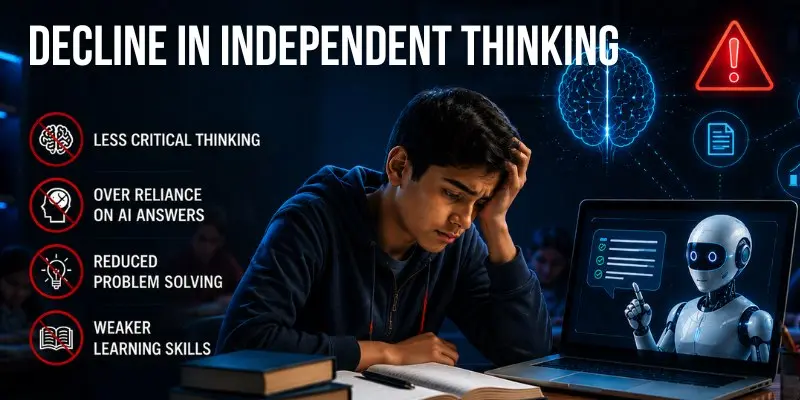
Independent thinking is a core skill that education aims to develop. The frequent reliance on automated tools can discourage students from exploring ideas or solving problems without assistance. When students accept answers without questioning them, their reasoning ability may weaken. Researchers studying the dark side of AI in education often warn that reduced analytical thinking is one of the most serious AI learning disadvantages.
Passive Learning Habits
Overdependence on technology can also lead to passive learning behavior. Instead of actively engaging with lessons, students may simply follow automated suggestions and explanations. This habit reduces curiosity and limits deeper understanding of complex topics. Over time, such patterns can increase the risks of AI in schools, as students become less motivated to practice critical thinking and independent research.
Declining Critical Thinking Skills
One of the most discussed risks of AI in education is the gradual decline in critical thinking abilities among students. When learners depend heavily on automated tools for answers, they may stop questioning information or exploring different perspectives. This habit can weaken reasoning skills that are essential for academic success and real-world problem solving. Experts studying the dark side of AI in education warn that excessive reliance on digital assistance may contribute to several negative effects of AI in education, particularly in how students analyze and understand complex subjects.
Accepting AI Answers Without Question
Many students now receive instant responses from digital learning tools. While quick answers save time, some learners accept these responses without verifying accuracy or understanding the reasoning behind them. This behavior can reduce curiosity and discourage deeper investigation of academic topics. Researchers examining the problems with AI in education highlight that unquestioned reliance on automated answers may weaken independent learning habits and critical evaluation skills.
Reduced Analytical Thinking
Analytical thinking develops when students evaluate information, compare ideas, and build logical arguments. However, frequent dependence on automated explanations can limit opportunities to practice these skills. When learners skip the process of analysis, their understanding of subjects becomes superficial. Educators concerned about the AI impact on students often note that this shift may create significant AI learning disadvantages in subjects that require reasoning and interpretation.
Long-Term Impact on Problem-Solving Skills
Problem solving is one of the most valuable abilities education provides. Students learn to approach challenges, test solutions, and refine their thinking through experience. If automated tools complete these steps for them, students may struggle to solve problems independently in the future. This long-term effect represents a serious concern within the broader debate about the risks of AI in schools, as it may influence both academic performance and professional readiness.
Academic Integrity and Cheating Concerns
Academic integrity is a fundamental principle of education. However, the rapid use of digital learning tools has introduced new challenges for schools and universities. Many educators now worry about AI cheating in schools, where students rely on automated systems to complete essays, assignments, and research tasks. This situation highlights several risks of AI in education, particularly when technology replaces genuine learning effort. Experts discussing the dark side of AI in education often emphasize that these practices may create serious negative effects of AI in education, including weakened academic standards and reduced student accountability.
AI-Generated Essays and Assignments
Automated writing tools allow students to produce essays and assignments within minutes. While these systems can assist with research or organization, some students use them to generate entire academic submissions. This practice raises concerns about originality and learning integrity. When assignments are completed through automated writing systems, the problems with AI in education become more visible, as students may receive credit for work they did not genuinely produce.
Difficulty Detecting AI-Assisted Cheating
Another challenge for educators is identifying when automated systems have been used improperly. AI-generated content can sometimes appear similar to human writing, which makes detection difficult. Teachers must now spend additional time reviewing assignments and verifying authenticity. This issue has increased the AI impact on teachers, as they must adapt assessment methods to address the growing risks of AI in schools.
Lack of Clear AI Usage Policies in Schools
Many educational institutions are still developing policies that define how digital tools should be used in academic work. Without clear guidelines, students may feel uncertain about what counts as acceptable assistance and what qualifies as misconduct. The absence of consistent rules contributes to confusion about academic honesty. Addressing these policy gaps is essential to reduce the dangers of AI in education and ensure that technology supports learning without compromising academic integrity.
Loss of Human Interaction in Education
Education has always relied on strong relationships between teachers and students. Communication, guidance, and mentorship help learners stay motivated and confident throughout their academic journey. As digital tools become more common in classrooms, some educators worry that personal interaction may slowly decrease. This concern is often discussed as part of the dark side of AI in education, where heavy dependence on automated systems can affect the social and emotional aspects of learning. While technology supports efficiency, the risks of AI in education become visible when meaningful human connections are reduced.
Reduced Teacher–Student Communication
Direct communication between teachers and students plays a critical role in learning. Through discussion and feedback, teachers help students understand complex topics and develop confidence in their abilities. When students rely more on digital tools for explanations, they may interact less frequently with their instructors. Researchers studying the AI impact on students note that reduced communication can weaken engagement and limit opportunities for personalized guidance.
Less Classroom Discussion and Collaboration
Classroom learning traditionally encourages debate, teamwork, and shared problem solving. These activities help students explore different viewpoints and strengthen their understanding of difficult subjects. However, when automated learning systems dominate the learning process, students may spend more time working individually with digital platforms. This shift can reduce collaborative learning experiences and contribute to several problems with AI in education, especially in subjects that require active discussion.
Weakening of Mentorship and Emotional Support
Teachers provide more than academic instruction. They also offer mentorship, encouragement, and emotional support that help students overcome challenges. These human qualities cannot be replaced by automated systems. When classrooms depend too heavily on digital tools, students may lose access to the mentorship that supports personal growth. Experts discussing the negative effects of AI in education often emphasize that preserving strong teacher-student relationships is essential for balanced learning environments.
Data Privacy and Security Risks
As digital learning systems expand, concerns about student information are becoming more serious. Many educational platforms collect personal and academic data to improve learning experiences and track progress. While this information helps schools monitor performance, it also introduces new risks of AI in education related to privacy and security. Experts discussing the dark side of AI in education often warn that weak data protection can lead to serious problems. Protecting sensitive information has therefore become a major issue within modern classrooms, especially as schools rely more on digital platforms.
Student Data Collection by AI Platforms
Many educational platforms gather large amounts of student information, including learning patterns, academic results, and behavioral data. This information is used to improve personalized learning and provide targeted feedback. However, collecting such data raises concerns about AI data privacy in education and how student information is stored or shared. Without clear safeguards, the problems with AI in education may include misuse of personal data or unauthorized access to sensitive records.
Risks of Data Breaches or Misuse
When educational systems store large amounts of student data, they also become potential targets for security breaches. If these systems lack strong protection, confidential information may be exposed or misused. Such incidents can damage trust between students, schools, and technology providers. Researchers studying the negative effects of AI in education highlight that strong security practices are necessary to reduce the risks of AI in schools and protect student identities.
Lack of Transparency in AI Algorithms
Another concern involves the lack of transparency in how digital learning systems operate. Students and educators often do not know how automated systems analyze data or make recommendations. This lack of clarity creates uncertainty about fairness and accountability. In discussions about AI bias in education, experts emphasize that transparency is essential for responsible technology use and for reducing the broader dangers of AI in education.
Bias, Inaccuracy, and AI Misinformation
Digital learning systems can process large amounts of information quickly, but they do not always produce accurate or balanced results. When students rely heavily on automated responses, they may receive information that is incomplete or misleading. This issue represents one of the growing risks of AI in education, especially when learners accept digital answers without careful verification. Experts discussing the dark side of AI in education often highlight concerns about accuracy, fairness, and reliability. These problems can lead to several negative effects of AI in education, particularly when incorrect information influences learning outcomes.
AI Providing Incorrect Information
Automated learning systems sometimes generate responses that appear convincing but contain factual errors. Students who depend on these responses may unknowingly learn inaccurate concepts or incomplete explanations. This problem becomes more serious when learners fail to verify information through reliable academic sources. Researchers studying the problems with AI in education warn that frequent exposure to incorrect answers can weaken knowledge development and create confusion in academic subjects.
Algorithm Bias in Educational Systems
Another challenge involves bias within digital learning systems. Algorithms are developed using large sets of data, and if this data contains bias, the system may produce unfair or unbalanced outcomes. In educational environments, this can influence how content is recommended or how student performance is evaluated. Discussions about AI bias in education highlight that biased systems may unintentionally reinforce inequalities, making it essential for institutions to examine the fairness of the technology they adopt.
Difficulty Identifying False or Misleading Content
Students often find it difficult to determine whether automated responses are accurate or misleading. Many digital explanations are written clearly and confidently, which can make incorrect information appear trustworthy. Without strong research skills, learners may accept that these responses are true. This challenge contributes to the broader AI misinformation in education debate and increases the risks of AI in schools, particularly when students rely on automated content instead of verified academic sources.
New Challenges for Teachers
The rapid adoption of digital learning systems has created new responsibilities for educators. Teachers now work in classrooms where automated tools assist with research, writing, and problem solving. While these technologies can support instruction, they also introduce several risks of AI in education that teachers must manage carefully. Educators must protect academic standards while guiding students to use technology responsibly. Discussions about the dark side of AI in education often highlight how teachers are adapting to these changes and addressing the AI impact on teachers in modern classrooms.
Monitoring Student Use of AI Tools
Teachers now need to observe how students use digital learning tools during assignments and research tasks. Some students rely heavily on automated systems to complete homework or generate responses. This situation requires educators to review student work more carefully and encourage responsible technology use. By monitoring these tools effectively, teachers can reduce the problems with AI in education and ensure that learning remains authentic.
Maintaining Academic Integrity
Protecting academic honesty has become more complex in technology supported classrooms. Educators must ensure that students submit original work and understand the concepts behind their assignments. The growing concern about AI cheating in schools has encouraged teachers to redesign assessments and use more discussion based learning activities. These strategies help limit the negative effects of AI in education while maintaining strong academic standards.
Adapting Teaching Methods in AI Classrooms
Teaching strategies must evolve as classrooms integrate digital systems. Teachers are increasingly focusing on critical thinking, creativity, and discussion based learning rather than simple memorization. These methods encourage students to analyze information instead of depending on automated answers. By adapting their instruction, educators can address the risks of AI in schools while helping students develop skills that remain valuable in technology driven environments.
Responsible Use of AI in Education
Technology can support modern classrooms when schools apply it thoughtfully and with clear guidance. As discussions about the dark side of AI in education continue to grow, educators are focusing on practical ways to reduce the risks of AI in education while still benefiting from digital learning systems. Responsible implementation requires strong policies, student awareness, and balanced teaching strategies. When institutions address concerns such as ethical concerns of AI in education and problems with AI learning tools, they can create a learning environment that protects both innovation and academic integrity.
Teaching AI Literacy to Students
Students need to understand how digital learning tools work and how to use them responsibly. Teaching AI literacy for students helps them recognize the risks of using AI in schools and avoid overdependence on automated answers. When learners develop skills such as verifying information and questioning digital outputs, they are better prepared to identify AI misinformation in school learning. This knowledge encourages responsible technology use and strengthens independent thinking.
Creating Clear Ethical Guidelines
Educational institutions must develop clear policies that define acceptable and unacceptable uses of technology. These rules help prevent AI cheating problems in schools and reduce confusion about academic honesty. When schools establish strong guidelines for assignments, research tasks, and digital tools, they protect academic standards and ensure fair evaluation. Addressing ethical concerns of AI in education also helps teachers and students understand how technology should support learning rather than replace genuine effort.
Balancing Technology with Human Teaching
Technology should assist teachers rather than replace their role in the classroom. Strong teaching depends on mentorship, discussion, and direct guidance that cannot be replicated by automated systems. When schools maintain this balance, they reduce the impact of AI on traditional learning and preserve meaningful teacher-student interaction. Combining human instruction with responsible digital support helps create a healthy learning environment where technology strengthens education instead of weakening it.
The Future of AI in Education(Balancing Innovation and Risk)
Education systems around the world are entering a period of rapid transformation. Digital learning tools will continue to evolve and become more common in classrooms, online platforms, and academic research. While these developments offer new opportunities for efficiency and personalized learning, schools must also consider the future risks of AI in education and the long term impact of AI on classroom learning. A balanced approach is essential to ensure that technology strengthens education without creating new problems for students and teachers.
AI Will Continue Expanding in Schools
Educational institutions are likely to adopt more advanced digital learning platforms in the coming years. These systems can support lesson planning, student progress tracking, and interactive learning activities. As the future of AI in schools continues to develop, classrooms may include more technology driven learning tools that assist both teachers and students. However, experts emphasize the importance of understanding the future challenges of AI in education before expanding its use widely.
The Need for Responsible Integration
Introducing technology into classrooms requires careful planning and strong educational policies. Schools must evaluate how digital tools influence student behavior, learning habits, and academic integrity. Responsible implementation helps reduce the risks of using AI in schools and addresses the growing ethical concerns of AI in education. When institutions create clear strategies for responsible use, they can ensure that innovation supports learning rather than weakening academic standards.
Human Teachers Remaining Essential
Despite technological progress, teachers remain the most important part of the educational process. Educators provide mentorship, encouragement, and real time feedback that technology cannot fully replace. Many experts agree that the impact of AI on traditional learning should focus on supporting teachers rather than replacing them. Maintaining strong teacher involvement helps protect student engagement and ensures that education continues to develop both intellectual and personal growth.
Conclusion
In this article, we explored the dark side of AI in education and the challenges that schools, teachers, and students must recognize. We discussed issues such as overdependence on digital learning tools, declining critical thinking skills, academic integrity concerns, data privacy risks, and the spread of inaccurate information. We also examined how these changes affect classroom interaction and create new responsibilities for teachers. Understanding these concerns helps reveal the real risks of AI in education and why responsible use is necessary for healthy learning environments.
My personal recommendation is simple, folks. Schools should treat technology as a helpful
thinking skills, verify information carefully, and value the guidance of their teachers. When technology and human teaching work together, education becomes stronger and more meaningful.
The future of education will continue to evolve, and staying informed will help everyone adapt wisely. Keep learning, stay curious, and stay tuned for more insights about the changing world of education.
Frequently Asked Questions (FAQs)
What are the dangers of AI in education?
Many educators discuss several dangers related to modern learning technology. The most common concerns include overdependence on automated study tools, reduced independent thinking, and increased academic dishonesty. Researchers also point to issues such as privacy risks and inaccurate information generated by digital learning platforms. Understanding these dangers helps schools address the negative impact of AI on education and encourages responsible use of technology in classrooms.
Does AI reduce students’ critical thinking?
Some studies suggest that excessive reliance on automated learning tools can weaken reasoning skills. When students receive quick answers without working through problems, they may lose opportunities to practice analysis and logical thinking. This situation raises concerns about whether AI reduces critical thinking in students over time. Teachers often encourage discussion, research, and problem solving to maintain strong intellectual development.
Can AI cause cheating in schools?
Yes, technology can sometimes create new opportunities for academic dishonesty. Some students use automated writing or homework tools to generate assignments instead of completing them independently. This behavior has led to growing discussions about AI cheating problems in schools and how teachers can identify misuse. Many institutions now redesign assessments and classroom activities to reduce the risk of cheating using AI tools.
Is AI safe for student data?
Digital learning platforms often collect student information such as performance data and study patterns. While this data can help improve personalized learning, it also raises questions about AI data privacy in education systems. Weak security practices may expose sensitive information or allow unauthorized access. Schools must ensure strong protection measures to reduce student data privacy risks in AI learning platforms.
How should schools regulate AI use?
Educational institutions should establish clear policies that guide responsible technology use. Schools can create rules for assignments, research tasks, and acceptable use of digital tools during academic work. Teaching digital literacy and ethical guidelines also helps students understand proper usage. By developing thoughtful policies, institutions can reduce the risks of using AI in schools responsibly while protecting academic integrity and student learning.






- Be Respectful
- Stay Relevant
- Stay Positive
- True Feedback
- Encourage Discussion
- Avoid Spamming
- No Fake News
- Don't Copy-Paste
- No Personal Attacks
- Be Respectful
- Stay Relevant
- Stay Positive
- True Feedback
- Encourage Discussion
- Avoid Spamming
- No Fake News
- Don't Copy-Paste
- No Personal Attacks
