The Truth About AI in Education: Benefits, Risks, and Future Impact
Published: 1 Jun 2026
It is 11 PM. You missed today’s lecture, your classmate’s notes are half readable, and the exam is close. Your teacher cannot explain it again, because there are dozens of other students to teach.
A few years ago, that meant falling behind. Today, many students open an AI tool and ask it to explain the topic again, step by step. That is the gap AI in education is starting to fill. But the same tools also raise real concerns, so is AI helping education or hurting it?
In this guide, we will examine the real role of AI in education across schools and universities. We will explore how AI for students and AI for teachers is reshaping learning, assessment, and classroom management. We will also address the advantages, the disadvantages, and the deeper concerns surrounding modern education technology. By the end, you will gain a clear, balanced understanding of what AI is truly changing.
Key Takeaways
- AI in education supports personalized learning, tutoring, grading, and school administration.
- Students gain the most when they use AI to understand topics, not to skip the work.
- Teachers save time on marking and planning, but need training to use AI well.
- The main risks are weaker critical thinking, cheating, privacy, and bias.
- AI can support classrooms, but it cannot replace human guidance and mentorship.
- My advice: take help from AI, but do not trust it blindly.
Role of AI in Education
Artificial intelligence is becoming an essential part of how modern education functions in schools, colleges, and universities. The role of AI in education goes far beyond basic automation. It supports teaching, strengthens student engagement, improves administration, and enhances the overall education technology framework used in institutions today.
By integrating intelligent systems into daily academic processes, schools are creating more flexible and responsive learning environments. AI for teachers and AI for students is not about replacing human effort. It is about improving efficiency, accuracy, and learning outcomes.
Here are the most important roles AI plays in modern education:
1. Personalized Learning Experiences
One of the strongest contributions of AI in education is AI personalized learning. Students do not learn at the same pace, and traditional classrooms often follow a fixed structure. AI based learning systems analyze student progress and adjust lessons according to individual strengths and weaknesses.
This allows two students studying the same subject to receive different types of support. As a result, students stay more engaged and improve their understanding over time. For a deeper look, read our guide on AI personalization in learning.
2. Intelligent Tutoring Systems
Intelligent tutoring systems provide academic support outside regular classroom hours. These AI tutoring systems guide students step by step, offer explanations, and provide instant feedback. Many AI learning platforms now include tutoring software that acts as a study assistant.
For students who need extra help or revision support, these systems create a more independent and flexible learning experience.
3. Automated Assessment and Grading
Assessment takes significant time in traditional teaching. AI grading systems and automated grading tools help evaluate quizzes, assignments, and even written responses efficiently. This reduces workload for teachers and improves speed in feedback delivery.
AI assessment tools also track patterns in performance, helping educators understand where students struggle the most.
4. AI Classroom Support and Student Assistance
AI educational chatbots and AI teacher assistant tools provide real time responses to student questions. These systems help with homework guidance, concept clarification, and general academic support. In smart classrooms, AI tools for education assist teachers in managing discussions and monitoring engagement.
This creates a more interactive AI classroom environment where support is available beyond school hours.
5. Administrative Efficiency and Data Insights
The impact of AI on education is also visible in administration. Schools use AI driven analytics to manage student records, monitor attendance, and evaluate institutional performance. In higher education, these systems help analyze trends and improve academic planning.
This integration supports the broader digital transformation in education by making decision making more data informed and efficient.
From AI learning apps to AI tutoring software and grading systems, technology is reshaping how education operates at every level. When used responsibly, artificial intelligence in education strengthens learning without replacing the human connection that remains essential in every classroom.
Benefits of AI in Education
The benefits of AI in education are changing how students learn and how teachers manage classrooms. AI in education improves learning speed, increases efficiency, and supports better academic decisions. From AI personalized learning to AI driven analytics, modern education technology is creating a more effective and structured system.
Here are the following benefits of AI in Education:
1. Personalized and Adaptive Learning
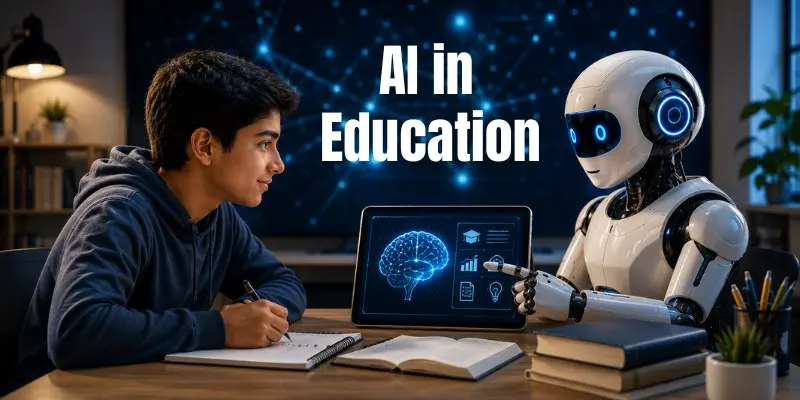
One of the strongest benefits of AI in education is its ability to adjust learning according to individual needs. AI personalized learning and AI based learning systems analyze student progress and modify lessons accordingly. Adaptive learning platforms work in the same way, which helps students understand concepts more clearly.
2. Increased Efficiency for Teachers
AI for teachers improves productivity inside the classroom. Tools such as AI lesson planning, automated grading, and AI assessment tools reduce administrative pressure. Teachers can:
- Evaluate assignments faster
- Spend more time guiding students
- Improve teaching quality and classroom engagement
3. Continuous Academic Support for Students
AI tutoring systems and AI learning apps provide support beyond school hours. Many platforms include an AI study assistant that helps with revision and homework tasks. AI for students encourages independent practice and builds stronger problem solving skills. This consistent support increases confidence and academic stability.
4. Smarter Decision Making in Institutions
AI driven analytics and machine learning in education help schools track academic trends and identify learning gaps. In AI in higher education, these systems support planning and performance evaluation. Education technology becomes more organized when institutions use data to improve strategies. This leads to better resource management and academic outcomes.
5. Improved Accessibility and Flexible Learning
AI tools for education enhance learning through AI in online learning platforms and smart classrooms. Students can access lessons anytime and review difficult topics at their convenience. This flexibility supports different learning styles and strengthens engagement.
AI also supports inclusive learning. Tools such as speech to text, text to speech, and translation help students with different learning needs and students who study in a second language.
A Real Campus Example: BEMS at GCUF
I saw this firsthand during my five year BEMS (Bachelor of Eastern Medicine and Surgery) program at Government College University Faisalabad (GCUF).
Medical and healthcare curricula are notoriously demanding. Subjects like complex physiological pathways, anatomy, and pharmacology require immense conceptual clarity. Whenever students missed a lecture due to a long commute or personal emergency, borrowing rushed handwritten peer notes was rarely enough.
Instead, students began turning to AI tools as personal study assistants to:
- Break down dense medical mechanisms into simple, step by step analogies
- Run self assessment quizzes before exams
Those who used AI thoughtfully consistently showed stronger conceptual understanding and achieved noticeably higher marks.
AI for students encourages independent practice, builds stronger problem solving skills, and reinforces academic stability so that missing a single lecture does not mean falling permanently behind.
How Students Can Use AI Responsibly
AI helps most when it supports your thinking instead of replacing it. Use this simple approach:
- Ask for explanations, not final answers. Request a step by step breakdown, then try the problem yourself.
- Quiz yourself. Ask the tool to create practice questions, answer them first, then check.
- Verify what it says. Compare important facts with your textbook, lecture notes, or teacher.
- Write in your own words. Never submit AI generated text as your own work.
- Follow your institution’s rules. Policies differ, so check what is allowed.
My Take: Use AI, but Never Trust It Blindly
When I start working on a project, I feel that AI is a good thing and that we should take help from it. But I have also seen AI make many mistakes while working, and I had to fix those things myself.
AI tools definitely make work easier. We should take help from them, but we should not trust AI blindly.
Generative AI and ChatGPT in Classrooms
Generative AI tools built on large language models (LLMs), such as ChatGPT, have changed how many students study. They can explain a concept in simple words, summarize a chapter, draft an outline, or create practice questions. Teachers also use them to prepare lesson plans, quizzes, and examples.
UNESCO has also addressed this. Its 2023 guidance, listed on the European Commission school education portal, is described as its first global guidance on generative AI in education. It calls for a human centred vision and proposes that governments regulate these tools, including data privacy protection and an age limit for use.
The same tools can give answers that sound confident but are wrong, so everything needs checking. They also make it easy to copy generated text, which is why clear classroom rules matter. Schools that explain when AI is allowed, and how to credit it, handle this better than schools that simply ban it.
Disadvantages of AI in Education
While the benefits are clear, the disadvantages of AI in education also deserve attention. Rapid growth of AI in education has raised concerns among teachers, parents, and policymakers. Understanding these challenges helps institutions use education technology more responsibly.
Here are the main disadvantages of AI in education:
1. Reduced Critical Thinking
One major concern is that AI for students may reduce independent thinking. When learners depend too much on AI homework tools or AI writing tools for students, they may stop analyzing problems deeply. Overuse can weaken reasoning skills and limit creativity in the long run.
2. Academic Dishonesty and Misuse
AI academic dishonesty is becoming a serious issue in schools and universities. AI and cheating in schools often involve students submitting work generated by AI systems. This creates unfair academic advantages and challenges traditional evaluation methods.
Some schools use AI detectors to catch this, but detection is not always reliable. Clear policies and process based assignments are usually fairer than relying on a detector alone.
3. Privacy and Data Security Risks
AI systems collect large amounts of student data to function effectively. This raises risks of AI bias in education and possible misuse of personal information. Schools must protect sensitive data while using AI driven analytics and other digital tools.
4. Overdependence on Technology
Heavy reliance on AI learning apps and AI tutoring systems can make students less confident in solving problems independently. If technology fails, learning may slow down. Education technology should support learning, not replace human guidance.
5. Teacher Displacement Concerns
Some fear that AI replacing teachers could become a future reality. While AI for teachers improves efficiency, it cannot replace emotional support, mentorship, and classroom leadership. The human role in education remains essential for balanced development.
The negative effects of AI in education are real but manageable. Institutions must address the risks of AI in education through clear policies, ethical standards, and proper supervision. To explore these concerns in more depth, read the dark side of AI in education.
Impact of AI on Students
AI is directly shaping how students study, think, and complete academic tasks. While AI learning apps improve access to knowledge, they also influence study habits and critical thinking.
Key points:
- Improves learning speed through AI personalized learning systems
- Provides instant help using AI study tools for students
- Encourages independent practice with AI tutoring systems
- Supports flexible learning through AI in online learning platforms
- Raises concerns about AI and critical thinking skills
Why AI Literacy for Students Matters
Using AI well is a skill. AI literacy for students means knowing what these tools can do, where they fail, and how to check their answers. A student with this skill asks better questions, spots weak or false answers, and uses AI to learn instead of to copy. Schools that teach it early help students avoid the risks covered above.
Impact of AI on Teachers
AI is also transforming the daily work of educators, from lesson preparation to assessment and classroom management. When used properly, it reduces manual workload so teachers can focus on mentoring and student development.
Key points:
- Supports structured instruction through AI lesson planning tools
- Reduces workload with automated grading and AI grading systems
- Improves evaluation accuracy using AI assessment tools
- Provides insights with AI driven analytics for student performance
- Acts as support through AI teacher assistant tools
Why Teacher Training Matters
Tools alone do not improve teaching. Teachers need training to use AI for teachers effectively, including how to choose tools, check AI generated content, and set clear rules for students. Without that support, even good technology ends up unused or misused.
Ethical Issues and Risks of AI in Education
The rapid growth of AI in education has created ethical concerns that schools cannot ignore. While education technology improves efficiency, it also introduces risks related to fairness, privacy, and academic integrity.
Key points:
- AI bias in education when systems reflect unfair data patterns
- AI misinformation in education when inaccurate content goes unchecked
- Privacy challenges through large scale student data collection
- The need for strong AI policy in education to guide responsible use
- AI ethics in education to protect student rights
Clear policies and responsible implementation ensure that innovation supports learning without compromising trust, fairness, or academic standards.
Teachers and AI: What Stays Human
The question of AI replacing teachers is widely debated. While education technology improves efficiency, teaching involves more than delivering content. Human connection, emotional guidance, and mentorship remain central to effective learning.
Key points:
- AI tutoring systems provide academic help, yet they lack emotional understanding and personal motivation
- AI assessment tools evaluate performance, but teachers interpret behavior and learning challenges more deeply
- AI personalized learning adjusts content, yet teachers shape values and critical thinking
Artificial intelligence in education works best as a support system, not a substitute. For the full discussion, read Can AI replace teachers.
Future of AI in Education
As digital systems become more advanced, the role of AI in education will continue to expand across schools and universities. For a current look at the changes, see how AI is changing education this year.
Key points shaping the future:
- Growth of AI personalized learning to support individual academic paths
- Expansion of AI in higher education for research, planning, and performance tracking
- Development of AI skills for students to prepare them for modern careers
- Increased adoption of AI in online learning platforms and smart classrooms
- Stronger AI policy in education to ensure responsible and fair implementation
The future of education with AI depends on balance. When institutions combine innovation with responsibility, AI in education can support long term academic growth.
Conclusion
In this article, we examined the role of AI in education, its benefits and disadvantages, its impact on students and teachers, the ethical issues involved, and where the technology is heading.
A balanced approach remains essential. Institutions need strong AI policy in education, AI for students should strengthen skills and confidence, and AI for teachers should improve efficiency without removing the human connection. Responsible use will determine whether artificial intelligence in education improves long term outcomes or creates new challenges.
Education is ultimately about growth, discipline, and mentorship. My own advice is simple: take help from AI, but do not trust it blindly.
Frequently Asked Questions
1. What is AI in education?
AI in education is the use of intelligent digital systems to support learning and teaching. Schools use these tools to personalize lessons, automate grading, and track student progress.
2. What are the benefits of AI in education?
AI in education improves personalized learning and gives faster feedback. It saves teachers time through automated grading and lesson support, and gives schools data for better planning.
3. What are the risks of AI in education?
The main risks are data privacy concerns, academic dishonesty, and overdependence on digital tools. Schools need clear policies to manage them.
4. Will AI take over classrooms?
No. AI can support teachers, but it cannot replace mentorship, motivation, and emotional connection.
5. Is AI good or bad for education?
It is both, depending on use. It improves efficiency and access to learning, but misuse can weaken independent thinking. Balance determines its value.
6. How is AI changing education today?
AI is personalizing lessons, speeding up assessment, and helping schools identify learning gaps through data.
7. Should AI be allowed in schools?
Yes, when clear guidelines are in place. Monitoring and policy keep its use ethical and safe.
8. How does AI help students learn better?
It offers tailored practice and instant feedback, and many platforms adjust content to a student’s strengths and weaknesses.
9. Does AI reduce critical thinking skills?
It can if students depend on it completely. When used with guidance to explain concepts and test understanding, it can support deeper learning.
10. What is the future of AI in education?
Expect smarter classrooms, more personalized learning, and stronger AI policies. Long term success depends on balanced use and strong educational values.





- Be Respectful
- Stay Relevant
- Stay Positive
- True Feedback
- Encourage Discussion
- Avoid Spamming
- No Fake News
- Don't Copy-Paste
- No Personal Attacks
- Be Respectful
- Stay Relevant
- Stay Positive
- True Feedback
- Encourage Discussion
- Avoid Spamming
- No Fake News
- Don't Copy-Paste
- No Personal Attacks
