AI in Healthcare and Medical Diagnosis: Transforming Modern Medicine
Published: 21 May 2026
A doctor may have only minutes to review a scan, a lab report, and a patient’s full history before making a decision that changes someone’s life.
Delayed diagnosis, human error, and rising costs remain serious problems in medicine. Catching a disease early can often be the difference between a simple treatment and a life threatening complication, which is why hospitals need systems that read medical data quickly and flag hidden patterns.
That is where AI in healthcare and medical diagnosis is changing modern medicine. AI helps hospitals detect disease earlier, read medical images faster, support robotic surgery, and build personalized treatment plans from patient specific data. From cancer screening and radiology to dental diagnostics and drug research, it is becoming part of everyday care.
In this guide, you will learn how AI improves diagnosis accuracy, eases the load on healthcare professionals, and speeds up treatment planning, along with its benefits, challenges, real world applications, and where it is headed next.
What Is AI in Healthcare?
AI in healthcare means using software that learns from medical data to support doctors and hospitals. Traditional healthcare software mostly stores and organizes records. AI goes further: it studies patient records, symptoms, lab results, and scans continuously, and it improves over time as it sees more clinical data.
That lets it spot abnormalities in imaging reports, predict health risks before a condition becomes severe, and help hospitals cut unnecessary delays in diagnosis. It also works behind the scenes, helping hospitals monitor patients, manage operations, and personalize treatment.
Today, AI is already used across:
- Radiology departments and pathology labs
- Emergency care and intensive care monitoring
- Pharmaceutical research
Technologies Behind Modern Medical AI
Four core technologies power most medical AI:
- Machine learning: studies large medical datasets to find patterns people may miss, supporting disease prediction, patient risk assessment, and prioritizing critical cases. For example, it can scan thousands of records to spot early signs linked to heart disease, diabetes, or neurological disorders.
- Deep learning: processes data through many layers to catch fine detail in X-rays, MRI scans, CT scans, and tissue samples, which makes it especially valuable in radiology, cancer detection, and pathology.
- Natural language processing: reads and organizes unstructured text such as doctor notes, discharge summaries, and lab reports, so records are easier to search and doctors spend less time on paperwork.
- Computer vision: interprets visual data like ultrasounds and pathology images, highlights suspicious areas, and helps flag fractures, tumors, internal bleeding, and lung infections.
Why Healthcare Systems Are Adopting AI
Hospitals are being asked to do more, with more data and fewer people. Four pressures are driving adoption:
- Growing data: every patient interaction creates records, scans, lab results, and prescriptions, and managing them by hand is getting harder
- Rising costs: AI helps cut administrative work, allocate resources, and smooth workflows without lowering care quality
- Need for faster decisions: in emergency and critical care, delays hurt outcomes, and AI helps teams prioritize urgent cases
- Shortage of trained professionals in many regions: AI takes over repetitive tasks so doctors, radiologists, and lab specialists can focus on patients
Evolution of AI in Medical Diagnosis
Diagnosis once relied almost entirely on manual evaluation, physician experience, and repeated lab testing, which took time and paperwork. Three shifts changed that:
- Rule based expert systems: early tools followed instructions written by medical experts to flag symptoms and suggest diagnoses. They helped with limited tasks like lab data and record keeping, but struggled with complex or unusual cases.
- Learning models: as medical data grew, systems began learning from patient records instead of fixed rules, spotting relationships between symptoms, diseases, and outcomes across radiology, cardiology, pathology, and emergency medicine.
- Digital health records: electronic records replaced paper files, creating large databases of histories, imaging reports, and lab results that systems could learn from, and making information easier to share between departments.
Modern AI-Powered Diagnostic Systems
Today’s systems work in three main ways:
- Data driven diagnosis: pulling imaging, lab results, patient histories, and monitoring data together to support early detection and prioritize urgent cases
- Pattern recognition: comparing thousands of cases to catch warning signs, from cancer to heart and lung disease, that are hard to see manually
- Real time decision support: watching patient conditions continuously and alerting care teams to sudden changes in emergency and intensive care
How AI Is Transforming Healthcare
AI in healthcare is not limited to one corner of medicine. It is now used across radiology, pathology, emergency care, pharmaceutical research, hospital administration, and remote care, helping providers work faster and cut diagnostic delays.
1. Faster and Earlier Disease Detection
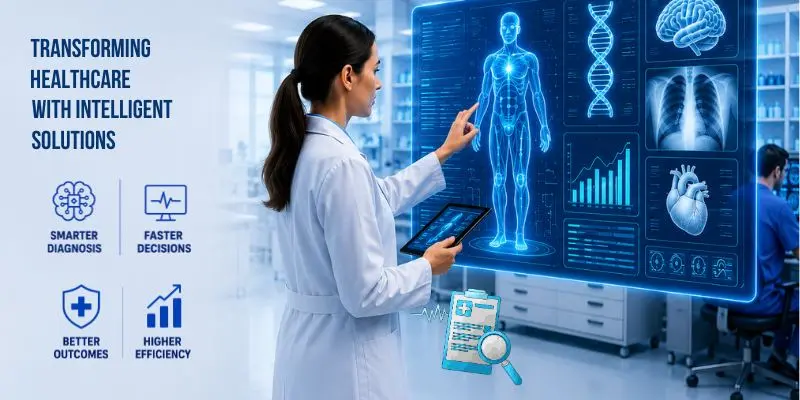
Early diagnosis is critical to successful treatment, and AI tools now help identify warning signs before symptoms become severe. That matters most for cancer, heart disease, neurological disorders, and respiratory illnesses, where early intervention can improve outcomes and reduce complications. In daily practice, it shows up in two ways:
- Speed: traditional diagnosis often means multiple evaluations, repeated tests, and long reporting, while AI processes data faster so doctors can review imaging, lab findings, and patient histories sooner
- Fewer reporting errors: in busy hospitals and emergency departments, AI adds a second layer of analysis that supports more accurate reports
Key areas of impact include:
- Chronic diseases: AI can help identify heart disease, neurological disorders, and respiratory illnesses at earlier stages, and predictive tools help hospitals monitor high risk patients
- Cancer: AI examines scans for breast cancer screening, lung cancer identification, and tumor analysis, and flags suspicious findings for further testing
- Diabetic eye disease: in 2018, the FDA permitted marketing of IDx-DR, the first AI device authorized to give a screening decision for diabetic retinopathy without a clinician interpreting the image, which allows screening in primary care settings
2. Medical Imaging, Radiology, and Pathology
Doctors rely on scans and lab reports to diagnose serious disease, and AI helps them read that data faster and more consistently. AI helps radiologists read X-rays, MRI scans, and CT scans by highlighting suspicious areas and prioritizing urgent cases, which supports faster reporting in busy radiology departments.
- Radiology: Radiology departments review large numbers of X-rays, MRI scans, and CT scans every day. AI helps by:
- Highlighting suspicious areas that need a closer look
- Supporting the detection of fractures, tumors, infections, and internal injuries
- Easing the load on radiologists when scan volumes are high (Radiology is also where regulated AI tools are most common. The majority of devices on the FDA’s list of AI-enabled medical devices are radiology products, which shows how far imaging AI has moved from research into clinical use.)
- Pathology and Laboratory Analysis: Digital pathology helps pathologists examine tissue samples at a microscopic level and spot disease related abnormalities, while automated lab reporting organizes results faster and improves communication between departments.
(For a deeper look at imaging in cancer screening, read our guide on AI in Cancer Detection and Medical Imaging.) - Dentistry and Dental Diagnostics: Dentists use AI to analyze dental X-rays and catch cavities, gum disease, and structural problems earlier, while automated tools support orthodontic planning and smile simulations that help patients see expected results. Several dental X-ray analysis tools also appear on the FDA’s list of AI-enabled devices.
3. Robotic Surgery and Smart Surgical Systems
Robotic surgery gives surgeons more precision, stability, and control, and AI adds real time guidance during delicate procedures. These systems are widely used in cardiac surgery, neurological procedures, and minimally invasive operations. For patients, smaller incisions often mean less pain, less blood loss, and faster healing.
(Explore our full guide on AI in Robotic Surgery and Smart Surgical Systems, or read about robotic knee replacement surgery for a procedure specific look.)
4. Drug Discovery and Personalized Treatment Planning
Every patient responds to treatment differently, and developing new medicine traditionally takes years of research and testing:
- Drug Discovery and Pharmaceutical Research: AI helps researchers analyze compounds, study chemical structures to find promising candidates, and run clinical trials more efficiently by organizing data and identifying suitable participants, which can help shorten development timelines and support quicker innovation.
- Personalized Treatment Planning: AI helps doctors build plans around an individual’s condition, medical history, and diagnostic findings, instead of relying only on generalized approaches. On the patient side, personalized medicine uses genetic information, medical history, and individual conditions to guide therapy choices and support therapy planning with clinical data and patient monitoring.
5. Generative AI and Large Language Models in Healthcare
Generative AI is the newest layer of AI in healthcare. Unlike tools built to classify a scan or flag a risk, generative models create new content, such as text, summaries, and synthetic images, which makes them useful for language heavy work.
Researchers are exploring it in several areas:
- Clinical workflows and documentation: automating routine tasks such as drafting notes and summaries
- Diagnostic support and medical reports: helping clinicians draft reports and work through possible diagnoses
- Drug discovery and conversational tools: supporting research and patient facing question answering
It also has real limits. Generative models can produce confident but incorrect output, known as hallucinations, and a recent scoping review of generative AI in medicine points to model interpretability, ethical concerns, and validation in real clinical settings as open challenges. The FDA has said it plans to explore ways to flag devices that use large language model functionality in future updates of its AI device list.
Healthcare Operations and Patient Support
Behind the scenes and outside hospital walls, AI keeps healthcare systems running smoothly and expands access to care:
1. Hospital Automation and Workflow Efficiency
- Smart hospital management: coordinating patient care, tracking resources, and improving day to day operations
- Automated documentation: organizing clinical notes, patient histories, and treatment records, which saves staff a significant amount of time
- ICU monitoring: tracking vital signs in real time and alerting care teams to sudden changes so they can respond faster in emergencies
2. Predictive Healthcare and Risk Assessment
Instead of waiting for illness to appear, predictive tools look for risk early:
- High risk patients: hospitals can identify who is more likely to develop a serious condition, monitor them closely, and step in earlier
- Preventive care: AI analyzes patient histories, lifestyle factors, and clinical data to flag possible concerns before they become severe
- Disease progression: doctors can track how a condition is changing and adjust treatment plans as needed
3. Virtual Health Assistants and Patient Support
Not every healthcare need requires a hospital visit:
Remote care: doctors can monitor patients outside the hospital, which helps elderly patients, people with chronic conditions, and those in remote areas
Symptom checking: digital platforms help patients review common symptoms and get guidance, which improves access and can reduce unnecessary visits for minor issues
Appointment management: scheduling and patient communication are handled digitally, easing the workload on staff
Benefits of AI in Healthcare and Diagnosis
For hospitals and patients, the gains show up in six places:
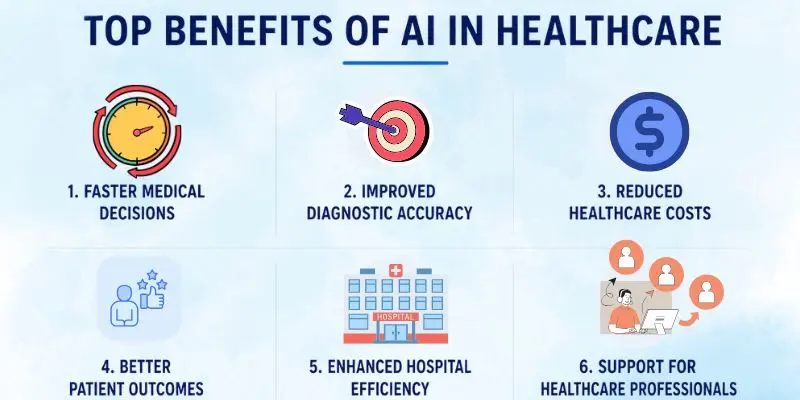
- Faster medical decisions: quicker analysis of patient information helps in emergencies and critical care
- Better diagnostic accuracy: scans, lab reports, and histories are analyzed together for more reliable treatment planning
- Lower costs: automation cuts administrative burden and helps hospitals use resources well
- Better patient outcomes: early detection and personalized care can improve treatment success
- More efficient hospitals: records, appointments, and communication between departments run more smoothly
- Support for professionals: less repetitive work for doctors, radiologists, nurses, and lab specialists, so they can focus on patient care
Challenges and Ethical Concerns
AI brings real risks, and providers have to manage them to keep patient trust:
- Patient data privacy: hospitals hold sensitive histories, reports, and treatment records, and protecting them from unauthorized access remains a major concern
- Bias in algorithms: if training data lacks diversity or accuracy, results may be unfair or inconsistent for some patient groups
- Explainability and reliability: doctors need to understand why a model flagged something, and AI tools need validation in real clinical settings
- Regulation and accountability: governments and health organizations are still working on policies for patient safety, data protection, and responsible use
- Over reliance on technology: if a system fails or gives inaccurate results, clinicians still need strong clinical judgment
AI supports doctors, but it cannot replace human expertise, patient communication, or medical ethics, so final decisions should stay under professional supervision.
Future of AI in Healthcare
Healthcare is moving toward prevention, personalization, and faster care:
- Predictive and preventive medicine: spotting disease risks before serious symptoms appear so prevention can start earlier
- Smart hospitals: connected digital systems, automated monitoring, and patient management platforms that may reduce delays
- Multimodal AI: models that combine different data types, such as medical images and text, are a growing shift in research
- Closer collaboration: doctors keep leading care while using AI for diagnosis, imaging analysis, and treatment planning
- Wider access to care: remote platforms may connect people in rural and underserved areas with specialists without long travel
Conclusion
AI in healthcare and medical diagnosis is changing how hospitals detect disease, read scans, support surgery, personalize treatment, and run daily operations. It helps doctors decide faster and work more accurately, and the most useful tools support clinicians rather than replace them.
For providers, medical students, and patients alike, staying informed about these tools is the best way to prepare for the future of care.
This article is for informational purposes only and does not replace professional medical advice. Please consult a qualified healthcare provider for diagnosis or treatment.
FAQs
1. How is AI used in healthcare and medical diagnosis?
AI analyzes medical records, imaging scans, lab reports, and patient data to support disease detection, treatment planning, and faster clinical decisions.
2. Can AI improve the accuracy of medical diagnosis?
It can. AI finds patterns in medical data that are hard to notice manually, especially in imaging analysis, cancer screening, and disease detection, but doctors make the final call.
3. What are the benefits of AI in healthcare?
The main benefits are:
- Faster diagnosis and fewer reporting errors
- Better patient care and personalized treatment planning
- Smoother hospital operations
4. Is AI replacing doctors?
No. AI supports medical professionals. Doctors remain central to diagnosis, treatment decisions, and talking with patients.
5. Is generative AI used in healthcare?
Yes. It is being explored for drafting clinical documentation, generating medical reports, diagnostic support, and drug discovery. It has limits, including incorrect output, bias, and difficulty explaining its reasoning, so clinicians need to review the results.
6. Are AI medical tools FDA approved?
Many are authorized by the FDA. The agency publishes a list of AI-enabled medical devices that have met its premarket requirements, and most are radiology tools. The list is not comprehensive, so for a specific tool, check its entry in the FDA database.
7. What is the future of AI in healthcare and medical diagnosis?
Expect more focus on:
- Early disease detection and preventive medicine
- Personalized treatment
- Smart hospitals and wider access to care





- Be Respectful
- Stay Relevant
- Stay Positive
- True Feedback
- Encourage Discussion
- Avoid Spamming
- No Fake News
- Don't Copy-Paste
- No Personal Attacks
- Be Respectful
- Stay Relevant
- Stay Positive
- True Feedback
- Encourage Discussion
- Avoid Spamming
- No Fake News
- Don't Copy-Paste
- No Personal Attacks
